


We're continuing How Democracies Fight Back, the new series for The Planet that follows The Strongman's Playbook. I published Part 1 last week, opening with institutional resistance: the D.C. Circuit blocking the White House ballroom against Todd Blanche’s Justice Department, with lessons drawn from Poland's Constitutional Tribunal and Brazil's Supreme Federal Tribunal. Today, I finalized Part 2, on legal resistance, judges, lawyers, and bar associations pushing back against executive overreach. The developments in the news kept the pace of this series so let’s open with a new chapter in the same White House ballroom story.
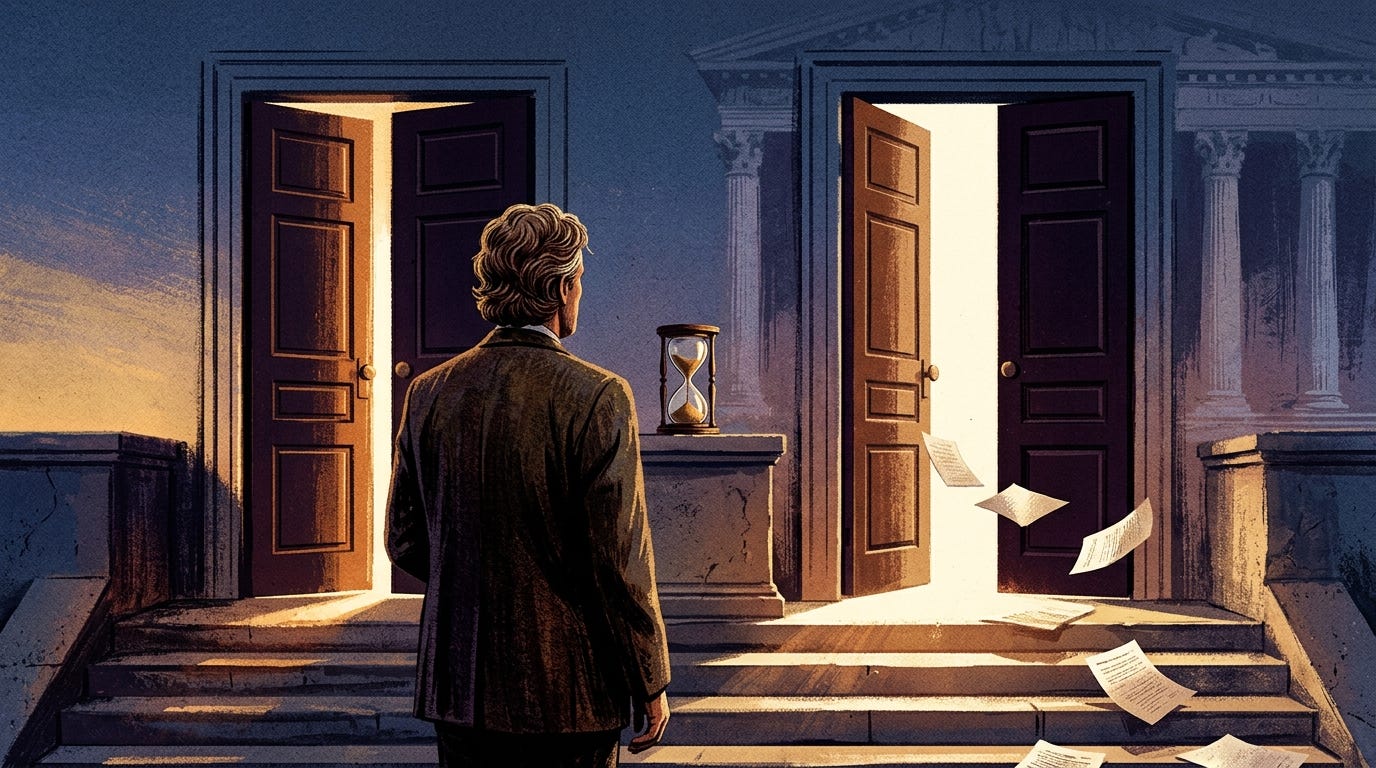
On Friday, August 21, two American courts issued rulings within hours of each other. Both involved Trump administration policies. Both were technically about a lower court’s “no.” And they ended up in almost opposite places. I want to walk through both carefully, because the difference between them is not a small legal technicality. It is close to the whole story of where American legal resistance stands right now.
Let’s start with the ballroom, since I already introduced this story in Part One. Quick recap: Trump wants to build a $400 million, 90,000-square-foot addition to the White House, a ballroom with an underground bunker attached. On August 7, the D.C. Circuit ruled, 2-1, that he cannot do this without congressional approval. The administration didn’t accept that. It asked the Supreme Court for an emergency stay, essentially asking the Court to let construction continue while the bigger legal fight plays out. The new development is that, on August 21, Chief Justice John Roberts said yes.
It’s easy to misread this as “the Supreme Court sided with Trump.” It didn’t, not exactly. Roberts did not rule that Trump has the legal authority to build the ballroom. There was no opinion explaining why. There was no recorded vote among the nine justices; this was Roberts acting alone, using a fast emergency process rather than the Court’s normal deliberation. The entire order is a single sentence pausing the lower court’s injunction until further notice. No reasoning is given at all.
So what actually changed? Nothing about who is right. The D.C. Circuit’s ruling still exists, on paper, exactly as it was written. What changed is that the ruling temporarily cannot be enforced. Construction keeps going. The disagreement about whether Trump was ever allowed to do this in the first place has simply been set aside, for now, without being resolved.
Now, let’s look at the second ruling, because this is where the day gets interesting. A few hours after Roberts’ order, in a federal courthouse in Manhattan, U.S. District Judge Jeannette A. Vargas issued a very different kind of decision. She struck down a State Department policy that had suspended immigrant visas for people from 75 countries, including Afghanistan, Brazil, Nigeria, and Somalia. The government’s justification was that people from those countries were more likely to become a “public charge,” a legal term for someone who might end up depending heavily on government assistance. Vargas wasn’t persuaded. She called the policy “patently unlawful.” Her reasoning, in plain terms, was this: immigration law requires the government to look at each visa applicant individually. The State Department had instead just banned entire nationalities at once, which the law doesn’t allow a cabinet secretary to do on his own authority.
Unlike the ballroom case, this ruling wasn’t paused or softened. Vargas vacated the policy entirely, immediately, for the whole country, not just for the people who happened to sue. The administration had tried to defend itself by pointing to the Supreme Court’s 2018 travel ban ruling, arguing this was basically the same thing. Vargas didn’t buy that comparison either. That older case was about the president deciding who gets to enter the country at all. This case was about whether a government department can rewrite the rules Congress wrote for handing out visas. Those are different questions, and she treated them as different questions.
So here is the contrast, laid out plainly. Two courts. Two rulings against the Trump administration, on the same day. One of those rulings, the ballroom, effectively stopped mattering within hours, paused by a single justice with no explanation. The other, the visa case, took full effect immediately and nationwide. Same government. Same day. Two completely different fates for a court saying no.
That contrast is more revealing than either ruling on its own.
It also turns out not to be an isolated week. Once you start looking, you find lower courts pushing back against this administration constantly right now, and mostly, their rulings are holding. On the same August 21, an appeals court in New York upheld a block on Justice Department subpoenas targeting New York’s attorney general, Letitia James, because the prosecutor who issued them had been appointed through a process that broke federal law. The day before that, on August 20, a federal judge in Virginia stopped the administration from getting its hands on sensitive data belonging to roughly 17 million commercial truck drivers, after twenty-two states and Washington, D.C. sued to block it. And a few days before that, an appeals court protected more than 1,400 churches, mosques, and other houses of worship from immigration enforcement near their doors, ruling that the administration’s policy change likely violated a federal religious freedom law.
None of those rulings has been undone. The ballroom is the exception, not the rule, at least so far.
But it’s a revealing exception. What it shows is that a fast, thinly explained emergency process exists, and that a government which loses in a normal court can sometimes go around that loss through the emergency docket, buying itself time without ever actually winning the argument. Winning a case properly can take years of appeals. Getting an emergency stay can take days. If you’re an administration that keeps losing, that shortcut starts to look very useful.
There’s another layer to this story that I think deserves just as much attention as the court rulings themselves, maybe more. It’s not only judges pushing back right now. It’s the legal profession itself, in ways that don’t always make headlines but that matter for how durable this resistance turns out to be.
Here’s one example. The American Bar Association is suing the Trump administration over what it calls a coordinated campaign to punish law firms, not for breaking any law, but simply for which clients they represented and which legal positions they took. That lawsuit has already survived an attempt by the government to get it thrown out; a judge ruled the ABA had a real case. So when the court recently tried to find out who inside the administration actually designed this policy, the Justice Department’s answer was essentially, "That’s privileged information; we don’t have to tell you."
Here’s a second example, and I find this one genuinely moving. A group of 128 former judges, federal and state, retired people who spent their entire careers on the bench, filed a formal ethics complaint. Their target was a Homeland Security lawyer named James Percival, who has taken to publicly attacking sitting judges who rule against the administration, at one point publishing something he called a “Worst of the Worst, District Judge Edition” list. Percival’s response to being called out by 128 former judges was to mock them, announcing a sarcastic “award” named after the woman who organized the complaint. But sit with that complaint itself for a moment. These aren’t political activists. These are people who spent decades inside the system, and their message, formally, on the record, was simple: this is not how a government lawyer is supposed to talk about judges.
And then there’s the ABA itself, which in early August formally adopted a pledge to defend judicial independence, and which had already issued a detailed opinion, weeks earlier, spelling out when government lawyers have an ethical duty to speak up if they know their bosses are breaking the law. None of that creates new binding law. But it puts on the record that government lawyers can no longer easily claim they didn’t know where the line was supposed to be.
None of this stops a bad policy on its own. But I think it might matter more, in the long run, than any single court case. A court’s ruling can be paused by one justice with a single sentence. A professional culture, one that treats attacking judges as genuinely unacceptable, is much harder to switch off with an order.

I’ve seen something like this before, in a very different country. When Poland’s Law and Justice party came to power in 2015 and began undermining the courts, one of the most important responses came from an organization called Iustitia, the country’s main independent association of judges. Iustitia wasn’t new. It had existed since 1990. But its role changed sharply after 2016, as government pressure on judges intensified. Individual judges were suspended. Some had their pay cut. Some faced disciplinary hearings simply for the rulings they’d made. Iustitia documented every bit of it, year after year, in detailed public reports. It didn’t stop the damage to Poland’s courts, not really, not in the short term. But that documentation later became part of the evidence that helped Polish society, and European institutions, understand what had actually happened.
I want to give you one more example, because it shows something different: what it looks like when resistance works quickly rather than slowly.
In December 2024, South Korea’s president, Yoon Suk-yeol, declared martial law out of nowhere and sent troops to physically block the National Assembly from meeting. He wanted to stop lawmakers from doing the one thing the constitution allowed them to do in that moment: vote his decree down. It didn’t work. Assembly staff, opposition politicians, and ordinary citizens confronted the soldiers outside and helped lawmakers get into the building. By one in the morning, the Assembly had voted 190 to nothing to demand Yoon reverse himself. He backed down before dawn. Ten days later, after an initial failed attempt, they impeached him, 204 to 85. Four months after that, in April 2025, South Korea’s Constitutional Court unanimously upheld the impeachment and removed him from office for good. Separately, in a criminal trial, he was later convicted of leading an insurrection and sentenced to life in prison.
What strikes me about South Korea is the speed. The legislature answered within hours, not years. The public didn’t wait to see how things would unfold; they showed up immediately. And when the moment eventually came for the courts to weigh in, months later, they backed the legislature’s decision unanimously, with a ruling that actually stuck.
Compare that to what’s happening in Washington right now. Nobody needs to storm any buildings. But underneath the paperwork, it’s a smaller, quieter version of the exact same question: when a president tests whether the rules still apply to him, does the answer come back fast enough, and firmly enough, to actually mean something? Poland’s answer, through its judges’ association, was years of patient documentation, a slow fight that by some measures still isn’t finished. South Korea’s answer was hours. America, right now, doesn’t look fully like either story. Most lower courts are still saying no, and mostly, that no is sticking. But one very visible exception just showed how a determined administration can find a shortcut around losing, through the emergency docket, without ever winning the actual argument.
The midterm elections are just over ten weeks away. I wouldn’t expect the Supreme Court to properly resolve the ballroom case before then, and honestly, that might be exactly the point. An emergency stay doesn’t need to last forever to do its job. It only needs to outlast the moment when the underlying question actually mattered. Keep an eye on whether this becomes a habit, whether the emergency docket increasingly becomes the place administration lawyers go, not because a case is truly urgent, but because winning the normal way simply takes too long to be useful. If that happens, the courts will still technically be resisting. It will just be happening in slow motion, while everything else moves at full speed.
This is the second installment of How Democracies Fight Back — a new series examining how democracies resist authoritarian consolidation. One front of resistance per installment. The historical cases do the argumentative work.
If you missed the previous series, The Strongman’s Playbook, it is all in the archive: ten parts on how authoritarian leaders consolidate power once they have won office. Together, the two series tell the complete story — how power is seized, and how it is resisted.
If you know an American who is watching the news and wondering whether any of this can still be stopped, send them Part 1. The courts and the Justice Department are where the story begins.
New subscribers get 20% off the first year.

More from Alexander Verbeek:
If you missed Part 1 of “How Democracies Fight Back”:
How Democracies Fight Back, Part One: What Institutional Resistance Looks Like Under Trump

On August 7, the U.S. Court of Appeals for the D.C. Circuit ruled 2-1 that the Trump administration could not continue above-ground construction of the White House ballroom without congressional authorization. A week later, on August 14, Trump asked the Supreme Court to let him resume construction. The project is officially priced at $400 million for a …
☕️ Daybreak Notes & Beans: Every morning before dawn, I search for the best news you didn’t see. Science breakthroughs, conservation wins, human kindness, and beauty — delivered in time for your first coffee. Published most days of the week, positive, and unapologetically hopeful.

✍️ More: where I publish 🧭 Morning Compass and 🎙️ Morning Comments
🧭 The Morning Compass is the best way to quickly catch up on the more serious news that’s going on during your first coffee. I also share what to expect in today’s news, what happened on this day in history, what I recently published, what I captured, and what I stumbled upon.
🎙️ My Morning Comments are short videos where I dive a little deeper into the story that stood out most that morning.

Screen Skills: A tech newsletter for non-tech people. Short, practical digital literacy guides for people who want to use their devices with more confidence. No jargon, no condescension. Usually, I publish it every other working day.

🎒 The Curious Wanderer
I write The Curious Wanderer for people who like to move through the world slowly and look at it carefully. If that sounds like you and you enjoy culture, history, and travel storytelling, you may want to join my travel newsletter. Please subscribe below; there is a paid option for those who want to support the writing directly.


Notes and sources
Ballroom emergency stay, primary source: Supreme Court docket, National Park Service, et al. v. National Trust for Historic Preservation - https://www.supremecourt.gov/docket/docketfiles/html/public/26a203.html
Ballroom stay reporting: ABC News, “Supreme Court chief justice allows construction on White House ballroom to continue” - https://ingest.abcnews.com/Politics/supreme-court-chief-justice-allows-construction-white-house/story?id=135846623
D.C. Circuit ruling background: Civil Rights Litigation Clearinghouse, National Trust for Historic Preservation v. National Park Service - https://clearinghouse.net/case/47494/
75-country visa policy vacated: Reuters, “US judge strikes down policy suspending immigrant visa processing for 75 nations” - https://www.reuters.com/legal/government/us-judge-strikes-down-policy-suspending-immigrant-visa-processing-75-nations-2026-08-22/
75-country visa policy remedy detail: PR Newswire, “Federal Court Strikes Down 75-Country Immigrant Visa Ban” - https://www.prnewswire.com/news-releases/federal-court-strikes-down-75-country-immigrant-visa-ban-302857714.html
Second Circuit blocks DOJ subpoenas against Letitia James: Reuters, “Appeals court upholds block on US Justice Department subpoenas to NY AG James’ office” - https://www.reuters.com/world/appeals-court-upholds-block-doj-subpoenas-ny-ag-james-office-2026-08-21/
Second Circuit vote breakdown: KQ2 News, “Trump US attorney pick can no longer investigate one of the president’s top foes, court rules” - https://www.kq2.com/cnn/cnn-us-politics/2026/08/21/trump-us-attorney-pick-can-no-longer-investigate-one-of-the-presidents-top-foes-court-rules/
Virginia CDL data case: FreightWaves, “States score win in fight over federal access to CDL driver database” - https://www.freightwaves.com/news/states-score-win-in-fight-over-federal-access-to-cdl-driver-database
Fourth Circuit protects houses of worship: Maryland Matters, “Appeals court upholds ban on immigration enforcement at some churches” - https://marylandmatters.org/2026/08/19/appeals-court-upholds-ban-on-immigration-enforcement-at-some-churches/
DOJ invokes privilege in ABA lawsuit: Reuters, “Trump invokes presidential privilege in lawsuit over law firm orders” - https://www.reuters.com/legal/government/trump-invokes-presidential-privilege-lawsuit-over-law-firm-orders-2026-08-18/
ABA lawsuit ruling on motion to dismiss: Justia Dockets & Filings, American Bar Association v. Executive Office of the President - https://docs.justia.com/cases/federal/district-courts/district-of-columbia/dcdce/1%3A2025cv01888/281674/43
128 former judges’ ethics complaint: The Daily Beast, “128 Former Judges File Ethics Complaint Against DHS Lawyer James Percival” - https://www.thedailybeast.com/senior-trump-dhs-official-james-percival-accused-of-inciting-violence-against-judges/
Percival “Worst of the Worst” series: Bloomberg Law, “Judges Urge DHS Lawyer to Remove Posts on ‘Worst’ of Judiciary” - https://news.bloomberglaw.com/litigation/judges-urge-dhs-lawyer-to-remove-posts-on-worst-of-judiciary-1
ABA Resolution 400 and independence pledge: American Bar Association, “ABA House adopts policies on professional independence, legal education, law enforcement at Annual Conference” - https://www.americanbar.org/news/abanews/aba-news-archives/2026/08/aba-hod-actions-annual-conference/
ABA Formal Opinion 524: American Bar Association - https://www.americanbar.org/news/abanews/aba-news-archives/2026/07/formal-opinion-524-re-govt-lawyers-obligations/
Iustitia history and activism: Cambridge University Press, “Civil Society Organizations for and with the Courts and Judges” - https://www.cambridge.org/core/services/aop-cambridge-core/content/view/78B99D55550E5668F9363F2A9FA827EB/S2071832221000729a.pdf
Iustitia disciplinary documentation, Juszczyszyn: Stowarzyszenie Sędziów Polskich Iustitia - https://www.do2024.iustitia.pl/en/103-news-en/4367-2-years-of-judge-pawel-juszczyszyn-s-suspension
South Korea martial law and impeachment chronology: Congressional Research Service - https://www.everycrsreport.com/files/2024-12-23_IN12474_3a5848c568e038f15f1b46f6272f287d22f33d24.pdf
South Korea impeachment vote: Reuters, “South Korea’s Yoon defiant after impeachment over martial law bid” - https://www.reuters.com/world/asia-pacific/south-koreas-yoon-faces-second-impeachment-vote-over-martial-law-bid-2024-12-14/
South Korea Constitutional Court ruling, primary source: Constitutional Court of Korea - https://english.ccourt.go.kr/site/eng/ex/bbs/List.do?cbIdx=1143
Yoon criminal conviction and sentence: Reuters, “South Korean court hands life in prison to ex-President Yoon for insurrection” - https://www.reuters.com/world/asia-pacific/south-korea-braces-verdict-expresident-yoons-insurrection-trial-2026-02-19/
"There’s another layer to this story that I think deserves just as much attention as the court rulings themselves, maybe more. It’s not only judges pushing back right now. It’s the legal profession itself, in ways that don’t always make headlines but that matter for how durable this resistance turns out to be."
The legal community as part of resistance is inspiring and promising. Keep talking to friends family, neighbors and make them aware of our reality. Get organized to assist in any capacity in the midterms: reminding your people to vote, escorting voters to the polls, monitoring or observing. Thank you, Alexander, for these significant updates and comparisons.
The Rule of Law. Lower courts as a whole are committed to upholding the laws as they are charged to do. Lawyers in servitude to a corrupt administration headed by an actual criminal scoff at the law and do whatever they can to circumvent law and justice. John Roberts is in that group.
Roberts’s quasi ruling is an affront to the law and the legal profession. The unwanted, unnecessary and illegal ballroom will be completed before a final ruling is issued by the Supreme Court. It’s Trump’s modus operandi and he’s used it many times in the past. Stall long enough to run out the clock or until the outcome becomes irrelevant.
Those legal stalwarts who’ve dedicated their lives to upholding the law and are now uniting in defense of legal ethics and the profession itself are doing exactly what they should. “A court’s ruling can be paused by one justice with a single sentence. A professional culture, one that treats attacking judges as genuinely unacceptable, is much harder to switch off with an order.”
We are in the classic battle of good v. evil, an age old battle that determines the future. I have worked with the law profession most of my adult life and I’m betting on the ethical legal community to rise up and beat back those making a mockery of the law and justice.
Part Two is another profoundly brilliant writing. Thank you.