

How Democracies Fight Back, Part One: What Institutional Resistance Looks Like Under Trump
A president who treats court rulings as suggestions, and an attorney general who treats independence as a talking point.

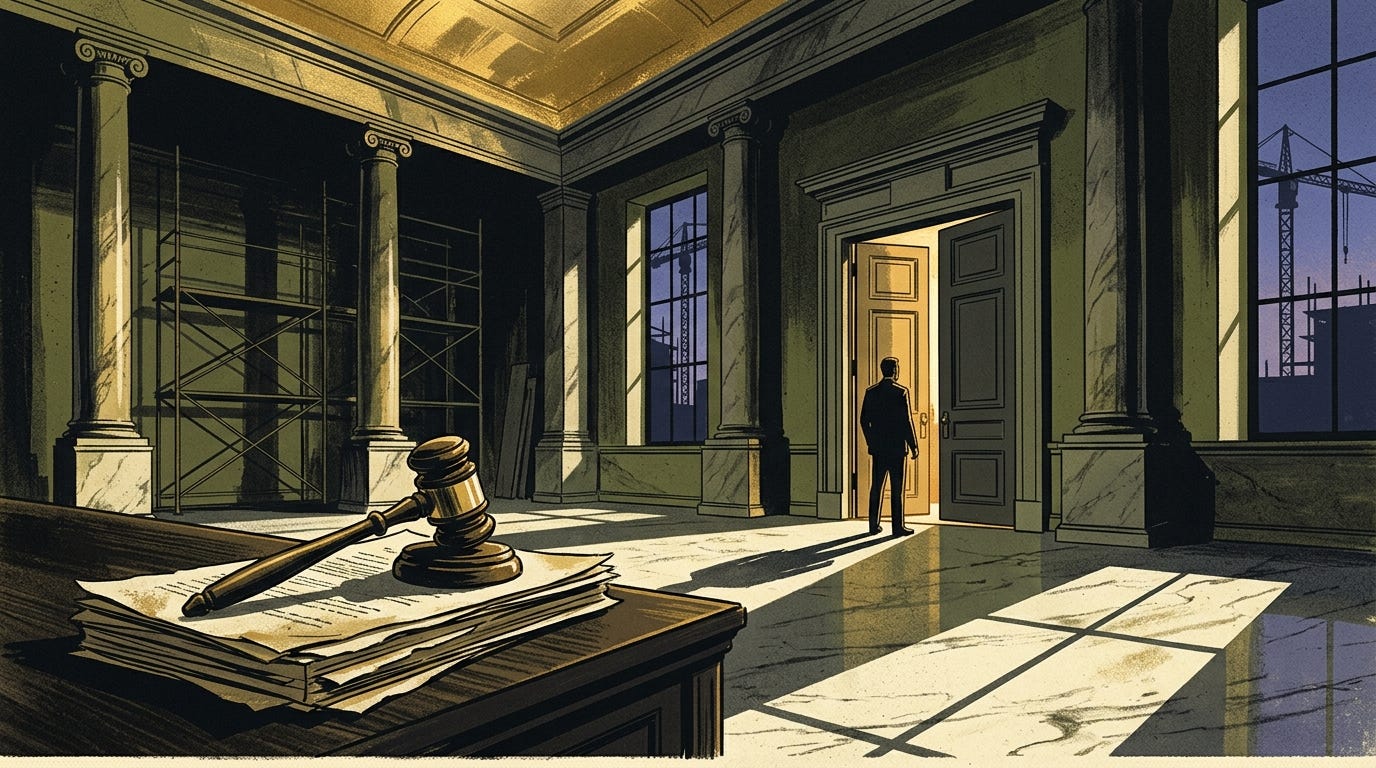
On August 7, the U.S. Court of Appeals for the D.C. Circuit ruled 2-1 that the Trump administration could not continue above-ground construction of the White House ballroom without congressional authorization. A week later, on August 14, Trump asked the Supreme Court to let him resume construction. The project is officially priced at $400 million for a 90,000-square-foot East Wing complex, though the broader cost of Trump’s White House renovations keeps moving. Trump’s response to the ruling was not to pause. He immediately asked the Supreme Court to overrule the appeals court, and in the meantime posted an AI-generated fantasy of himself showing George Washington around the ballroom, complete with its gold finishes, to a man who has been dead for 227 years.

I read that story and watched the ridiculous video on the Dutch island where I’m living this summer and thought about the absurdity of the ballroom saga. The instinct behind it is less absurd. A president who treats a court ruling as an obstacle to route around, rather than a decision to obey, shows us his disrespect for the other branches of government. District Judge Richard Leon, who issued the original injunction back in March, put it more precisely than I could: Trump is the “steward” of the White House, not “the owner.”
That distinction, steward versus owner, is the whole subject of this piece.
The day before the D.C. Circuit’s ruling, Todd Blanche gave his first full address to Justice Department employees as Senate-confirmed attorney general, sworn in after a 50-49 vote in which Susan Collins and Lisa Murkowski broke with their party. He spoke to a depleted workforce about integrity and the rule of law, about serving without fear or favor. By most accounts, the tone was reassuring, even ordinary. A listener with no other information would have heard a normal attorney general describing a normal department.
That is precisely the problem. This is the same Blanche who announced in March, at a conservative gathering in Texas, that more than 200 prosecutors and agents who had worked on Trump-related cases were no longer at the department, and who has publicly defended Trump’s sweeping January 6 clemency. During his confirmation process, Blanche pledged there would be “not even a whiff” of politically motivated investigations, while Senator Thom Tillis separately warned that even a whiff of a lack of independence could influence his vote. Then came a second indictment of James Comey, this time over an Instagram photo of seashells that prosecutors claimed were arranged to spell a threat against the president. A federal judge in a separate case involving an “8647” flag had already found compelling evidence that the display called for Trump’s removal but no evidence that it represented a true threat to his life or physical safety. The seashells have fared no better in the court of public opinion. The case is proceeding anyway.
This is what institutional capture can sound like from the inside. It rarely announces itself. It describes itself, in Blanche’s own words, as continuity, a department that succeeds when people of different backgrounds put the mission first. I don’t doubt that many people in that room wanted to believe him. What Blanche’s record suggests is that the department now treats loyalty to the president as compatible with, rather than opposed to, the independence it claims to uphold.
I want to be careful here, because it is tempting to sort every institution into simply captured or simply resistant, and the honest picture is more complex than that. Judges are still ruling against the administration. On August 11, less than three months before the November midterms, federal judge Indira Talwani again blocked Trump’s attempt to restrict mail voting through the Postal Service, warning about the chaos of changing voting rules that close to an election. On July 21, the D.C. Circuit unanimously upheld the contempt-of-Congress conviction of Trump adviser Peter Navarro for defying subpoenas from the January 6 committee, rejecting his executive-privilege defense because Trump had never actually invoked privilege on his behalf. That is a small but telling case: an insider who assumed the president’s protection would cover him, and a court that said it does not work that way.
But the more unsettling question is not whether judges are still ruling against the administration. It is whether those rulings are consistently obeyed. An Associated Press review found at least 31 lawsuits since February 2025 in which district judges concluded the administration had violated their orders, along with hundreds of additional instances of noncompliance in immigration cases. Appellate courts or the Supreme Court intervened in roughly half of those cases, sometimes allowing the administration to avoid immediate consequences for the delay. Judges are still saying no, but whether “no” still means what it used to is a different, harder question.
None of this is new. Other democracies have lived through exactly this moment, an executive testing how far institutions will bend before they break, some institutions holding and others quietly giving way. What happened next in those countries, whether the bending became permanent or the institutions eventually recovered, is not a matter of guesswork. It already happened. Two cases in particular tell you almost everything you need to know about what determines the outcome.
I have spent a fair amount of my working life around institutions built to survive exactly this kind of pressure in post-communist Europe. So the comparison I keep returning to is not the one that first comes to mind.
Poland lived through this same split: a judiciary under pressure on one side, a law-enforcement apparatus quietly absorbed into the government on the other, and it is worth understanding both halves separately.
Start with the courts. Poland’s version of a supreme court for constitutional matters is called the Constitutional Tribunal. When the Law and Justice party won power in 2015, it moved quickly against the Tribunal, packing it with loyalist judges appointed through an irregular process and gradually undermining its ability to function as an independent check on the government. That is the story most people outside Poland have heard, if they’ve heard anything.
Fewer people know the second half. In 2016, the government merged the office of justice minister with the office of prosecutor general, the official who runs the entire public prosecution service. One person now held both jobs, a politician and the country’s top law-enforcement official at once. That fusion is the far more direct parallel to what is happening at the American Justice Department right now. The Tribunal is closer to what the American judiciary is, a separate branch of government being pressured from outside. The prosecution service is closer to what the Justice Department is, part of the executive branch itself, and the one place where “independence” was never guaranteed by the constitution, only by norms, restraint, and the character of whoever happened to be in charge.

In 2023, Polish voters turned out in record numbers, 74.4 percent, and removed PiS from power. Donald Tusk’s new government began the slow work of restoring judicial independence. What Poland shows now, three years on, is not a clean success story. The European Union’s 2026 Rule of Law report notes that Constitutional Tribunal judgments are still not being published in the Official Journal, and the EU Court of Justice ruled as recently as December 2025 that the Tribunal’s own independence remains in question because of how those irregular judges were appointed back in 2015 and 2016. Parliament elected new Tribunal judges in March and June of this year, but legal scholars studying the process describe a court that still lacks full legitimacy. Winning an election, it turns out, does not automatically repair a captured institution. Repair takes years, sometimes longer than the political mandate meant to deliver it.
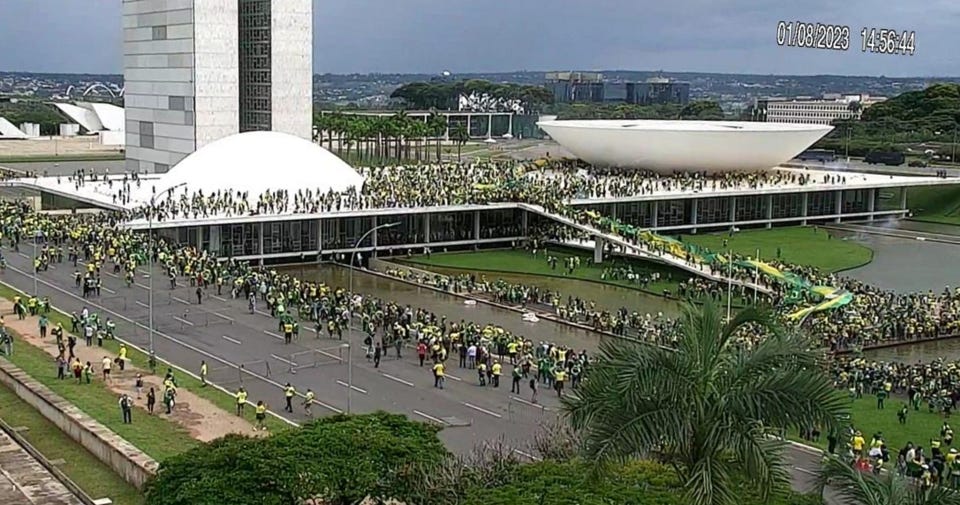
Brazil tells a different story, not because its institutions were flawless but because they retained enough independence to act when the crisis came. The Supreme Federal Tribunal had already faced sustained pressure from Bolsonaro and his movement well before January 8, 2023, when his supporters stormed government buildings in Brasília after his election defeat. But when that moment came, the Tribunal did not treat the assault as a political disagreement to be negotiated. It pursued the organizers, the financiers, and the political leadership behind it. By August 2025, Brazilian courts had held 1,190 people accountable, including 638 convictions. Bolsonaro himself was convicted in September 2025 and sentenced to 27 years and three months; the conviction became final in November. He is serving that sentence now.
The lesson is not that Brazil’s judiciary was uncaptured while Poland’s was captured. It is that institutions do not need to be flawless to matter. They need enough independence left, at the moment that it counts, to make an attack on democracy costly rather than free. Poland’s Tribunal had already lost that capacity by 2015. Brazil’s had not yet lost it by 2023. The difference between those two dates may be the most important variable in this entire piece.

Where does that leave the American Justice Department, and the American judiciary, right now? Somewhere between the two stories, and moving. The courts still resemble Brazil’s Supreme Federal Tribunal before its defining test: still capable of ruling against the president, even as the administration increasingly tests what those rulings actually mean in practice. The Justice Department under Blanche resembles Poland’s prosecution service in its later years, an institution that has learned to describe subordination as normalcy, formally independent, practically obedient.
There is a specific American test on the calendar that will tell you more than any speech from Todd Blanche. The midterms are less than three months away. Former Trump lawyer Ty Cobb has warned that Blanche may be less willing than William Barr was in Trump’s first term to resist the president if he tries to interfere with the vote. Cobb invoked Germany in 1934 to make the point. I would not make that comparison myself. But the underlying question is worth asking: what happens when an attorney general is asked to use the machinery of the Justice Department to influence an election?
I don’t think the outcome is written yet. Poland’s story took eight years to turn, and even now remains unfinished, not because any outside power intervened but because enough voters kept showing up. Brazil’s story turned faster because its judiciary held its ground before the pressure became impossible to resist. Both patterns are visible in America today, in different institutions, moving at different speeds. Some are still doing their jobs. Others are increasingly treating loyalty to the president as compatible with institutional independence. The weeks ahead will show how far that contradiction can travel, and whether elections, once again, are still the mechanism that corrects it.
This is the first installment of How Democracies Fight Back — a new series examining how democracies resist authoritarian consolidation. One front of resistance per installment. The historical cases do the argumentative work.
If you missed the previous series, The Strongman’s Playbook, it is all in the archive: ten parts on how authoritarian leaders consolidate power once they have won office. Together, the two series tell the complete story — how power is seized, and how it is resisted.
If you know an American who is watching the news and wondering whether any of this can still be stopped, send them Part 1. The courts and the Justice Department are where the story begins.
New subscribers get 20% off the first year.

More from Alexander Verbeek:
If you missed part 10 of The Strongman’s Playbook:
How Trump's America Is Engineering a System That Cannot Lose

On January 15, 2026, Reuters sat down with President Trump for a wide-ranging interview. The conversation turned to the midterm elections scheduled for November. Trump complained about the historical pattern of the president’s party losing seats at midterms. He talked about his administration’s accomplishments. Then he said:
☕️ Daybreak Notes & Beans: Every morning before dawn, I search for the best news you didn’t see. Science breakthroughs, conservation wins, human kindness, and beauty — delivered in time for your first coffee. Published most days of the week, positive, and unapologetically hopeful.

✍️ More: where I publish 🧭 Morning Compass and 🎙️ Morning Comments
🧭 The Morning Compass is the best way to quickly catch up on the more serious news that’s going on during your first coffee. I also share what to expect in today’s news, what happened on this day in history, what I recently published, what I captured, and what I stumbled upon.
🎙️ My Morning Comments are short videos where I dive a little deeper into the story that stood out most that morning.

Screen Skills: A tech newsletter for non-tech people. Short, practical digital literacy guides for people who want to use their devices with more confidence. No jargon, no condescension. Usually, I publish it every other working day.

🎒 The Curious Wanderer
I write The Curious Wanderer for people who like to move through the world slowly and look at it carefully. If that sounds like you and you enjoy culture, history, and travel storytelling, you may want to join my travel newsletter. Please subscribe below; there is a paid option for those who want to support the writing directly.


Notes and sources
Ballroom ruling (August 7) and Supreme Court appeal (August 14): PBS, “Trump asks Supreme Court to let White House resume ballroom construction during appeal” - https://www.pbs.org/newshour/politics/trump-asks-supreme-court-to-let-white-house-resume-ballroom-construction-during-appeal
Supreme Court filing details: The Guardian, “Trump asks US Supreme Court to allow construction of White House ballroom” - https://www.theguardian.com/us-news/2026/aug/14/trump-ballroom-supreme-court
Ballroom square footage breakdown: Axios, “White House ballroom, East Wing expansion: Design plan updates” - https://www.axios.com/local/washington-dc/2026/01/08/white-house-east-wing-expansion-ballroom-design-plans
AI-generated George Washington content: The Daily Beast, “Donald Trump, 80, Fantasizes About George Washington in Bizarre Posting Spree” - https://www.thedailybeast.com/donald-trump-80-fantasizes-about-dead-president-in-bizarre-truth-social-posting-spree/
Judge Leon’s March injunction and “steward, not owner” quote: The Washington Post, “Judge halts construction on Trump’s White House ballroom” - https://www.washingtonpost.com/politics/2026/03/31/judge-trump-white-house-ballroom/
Blanche’s first speech as attorney general: AP News, “Blanche seeks to rally a depleted Justice Department workforce in first speech as attorney general” - https://apnews.com/article/417872ffdf59331cf781c160a5a46d98
Blanche on 200+ departures: Senate Judiciary Committee, Blanche QFRs - https://www.judiciary.senate.gov/imo/media/doc/blanche_-_qfrs.pdf
“8647” flag ruling: Justia Law, Accountability Now USA v. Griess et al - https://law.justia.com/cases/federal/district-courts/district-of-columbia/dcdce/1%3A2026cv01385/291681/40/
Comey seashells case: AP News, “Comey says seashells post was political speech, not a threat, as he presses to dismiss charges” - https://apnews.com/article/068769e0ebf826a069212ab273915791
Trump administration court noncompliance review: The Washington Post/AP, “Takeaways from AP report on Trump administration’s defiance of lower court orders” - https://www.washingtonpost.com/national/2026/05/02/trump-courts-defiance-judges-lawsuits/
Talwani mail voting ruling: AP News, “Judge again bars Trump administration from implementing order that sought to limit mail voting” - https://apnews.com/article/159c192e48670a8740a6a378c683cb61
Navarro contempt conviction upheld: Justia Law, USA v. Navarro - https://law.justia.com/cases/federal/appellate-courts/cadc/24-3006/24-3006-2026-07-21.html
Poland Rule of Law report and Tribunal independence: EUR-Lex, 2026 Rule of Law Report - https://eur-lex.europa.eu/legal-content/EN/TXT/?qid=1784673012695&uri=CELEX%3A52026SC0921
EU Court of Justice ruling on Tribunal composition: EUR-Lex - https://eur-lex.europa.eu/legal-content/EN/TXT/?uri=oj%3AC_202602673
Poland 2023 election turnout: IPU Parline, Poland Sejm October 2023 Election - https://data.ipu.org/parliament/PL/PL-LC01/election/PL-LC01-E20231015/
Poland Tribunal judge elections March and June 2026: PAP, “Sejm wybrał nowych sędziów Trybunału Konstytucyjnego” - https://www.pap.pl/aktualnosci/sejm-wybral-nowych-sedziow-trybunalu-konstytucyjnego
Brazil January 8 accountability figures: Supremo Tribunal Federal, “January 8 anti-democratic acts: 1,190 people held accountable” - https://noticias.stf.jus.br/2025/08/15/january-8-anti-democratic-acts-1190-people-held-accountable/
Bolsonaro conviction and sentence: Reuters, “Brazil’s Bolsonaro sentenced to 27 years after landmark coup plot conviction” - https://www.reuters.com/world/americas/brazils-bolsonaro-sentenced-27-years-after-landmark-coup-plot-conviction-2025-09-11/
Thanks for the insightful analysis - sadly we can only dream that Trump will end like Bolsonaro
"Cobb invoked Germany in 1934 to make the point. I would not make that comparison myself. But the underlying question is worth asking: what happens when an attorney general is asked to use the machinery of the Justice Department to influence an election?"
Mechanisms are active to disrupt the midterms. We won't know until action takes place before, during, or after. Be prepared.