

How Trump's America Is Engineering a System That Cannot Lose
How Marcos, Franco, and Lukashenko tried to design their own permanence, and why Trump’s America is engineering the same system

On January 15, 2026, Reuters sat down with President Trump for a wide-ranging interview. The conversation turned to the midterm elections scheduled for November. Trump complained about the historical pattern of the president’s party losing seats at midterms. He talked about his administration’s accomplishments. Then he said:
“When you think of it, we shouldn’t even have an election.”
The White House subsequently called the remark facetious.
On March 30, 2025, in an NBC News interview, Trump was asked whether he was considering a third term despite the 22nd Amendment, which bars any person from being elected president more than twice. He replied: “I’m not joking.” He said there were “methods” by which he could serve again. Asked about one route — having Vice President JD Vance become president and then hand power back to Trump — he said: “Well, that’s one.” He added there were “others too.”
Three days after Trump’s inauguration in January 2025, Representative Andy Ogles of Tennessee introduced a constitutional amendment to allow a president to be elected three times. It went nowhere. On July 16, 2026, Trump used a primetime address to tell Americans that the electoral system was so compromised by foreign interference and domestic fraud that the upcoming November elections could not be trusted unless Congress immediately passed his preferred election laws. Several major networks declined to carry the speech live.
None of these statements, taken alone, proves that Trump intends to cancel elections or refuse to leave office. But that framing is too narrow. The strongman’s final technique is not the abolition of elections. It is the construction of a political system in which losing becomes very difficult, unfavorable results become easy to delegitimize, and the institutions that would resist a power grab have been weakened or captured. The technique does not require a declaration of dictatorship. It requires engineering the conditions in which democracy cannot reliably produce an unwelcome outcome.
This is the tenth technique in the strongman’s playbook. And it is the one that ties all nine preceding it together.
Ferdinand Marcos declared martial law in the Philippines in September 1972. By 1973 he had ratified a new constitution through a process widely condemned as coerced and illegitimate, one that gave him sweeping powers and eliminated the mechanisms by which he could normally be removed. He reorganized the military, placing loyalists in command. He detained political opponents, closed independent media, and built a business elite dependent on his favor. He created Kilusang Bagong Lipunan, his political party, as a vehicle for Marcos-aligned candidates at every level of government. In theory, he had made himself unremovable.

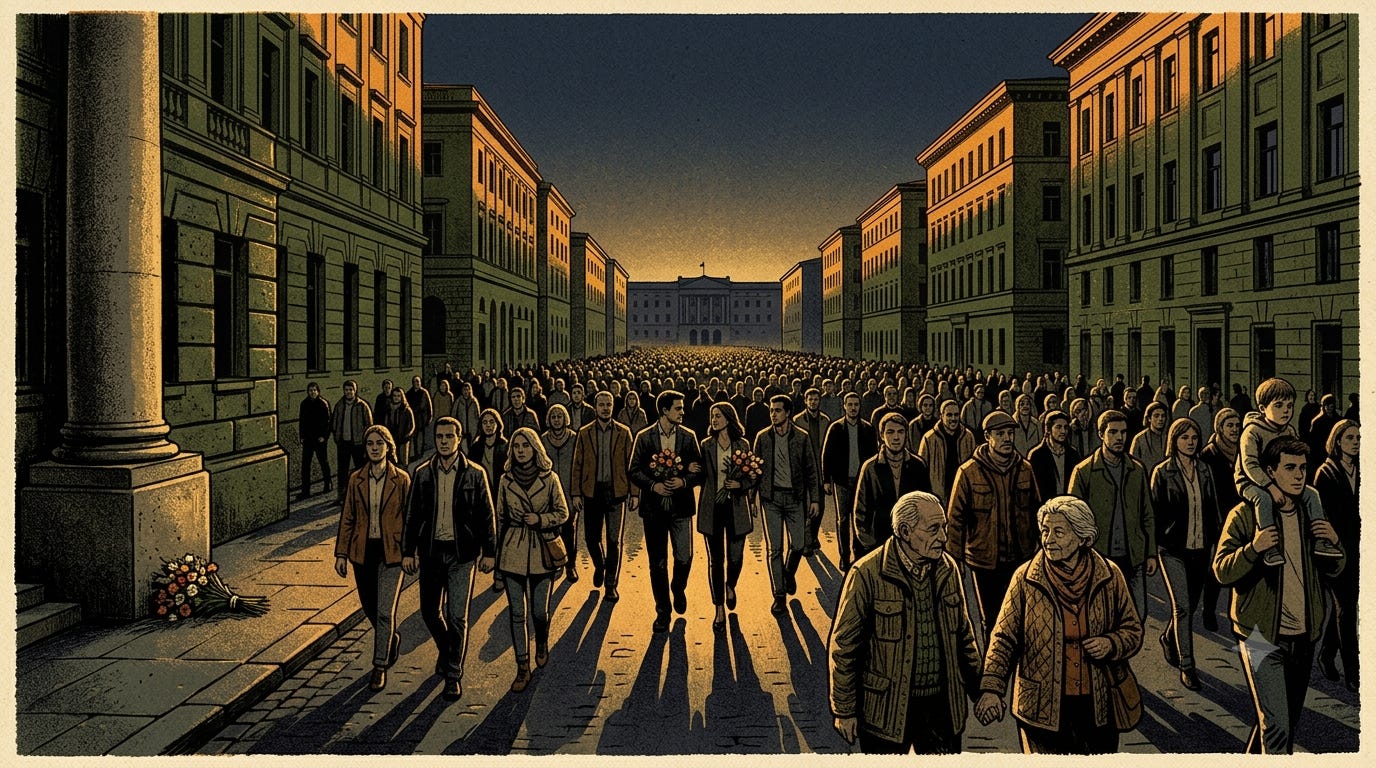
In February 1986, Corazon Aquino ran against him in a presidential election Marcos had called, expecting to win. When the results were manipulated in his favor, something unexpected happened. People did not wait for institutions to act. Ordinary Filipinos — millions of them — poured onto Epifanio de los Santos Avenue in Manila. They brought food and flowers. They stood in front of tanks. The tanks stopped.
That civilian presence on the streets was what broke the calculation inside the military. Only after the people had shown they would not be moved did General Fidel Ramos and Defense Minister Juan Ponce Enrile announce their defection. The military did not rescue the people. The people made it possible for the military to choose a side. The United States, which had supported Marcos for decades, then withdrew its protection and facilitated his evacuation to Hawaii, where he died in exile in 1989.
The system Marcos had built to make his removal impossible turned out to be brittle in the one way he had not anticipated: it depended on the people accepting that it was impossible. When they refused, the military calculated that its interests lay with the people rather than with the man. The business elite reached the same conclusion. The Americans followed.
Franco’s succession planning in Spain offers a different and in some ways more instructive version of the same story. Franco spent decades arranging his own irreplaceability and the continuation of his system beyond his death. He designated Juan Carlos of Bourbon as his successor in 1969, having cultivated him since childhood and believing he had trained a king who would preserve the Francoist state. He established Francoist institutions, Francoist laws, and Francoist elites at every level of Spanish society. He died in November 1975 believing the system would outlast him.
What followed was one of history’s great ironies. Juan Carlos chose democracy. He appointed Adolfo Suárez, a reformist, as prime minister. Together they guided Spain through democratic transition, legalizing political parties including the Communist Party, overseeing free elections in 1977, and dismantling the Francoist apparatus from the inside. The system Franco had spent thirty-six years constructing unraveled within three years, guided by the very man he had chosen to preserve it.
The lesson Spain offers is a hopeful and specific one: the loyalist successor is not always loyal to the system. Juan Carlos had been educated inside Francoism, groomed for it, and chosen because of his apparent reliability. He chose differently. Succession planning that depends on the successor’s continued loyalty is only as durable as that loyalty.
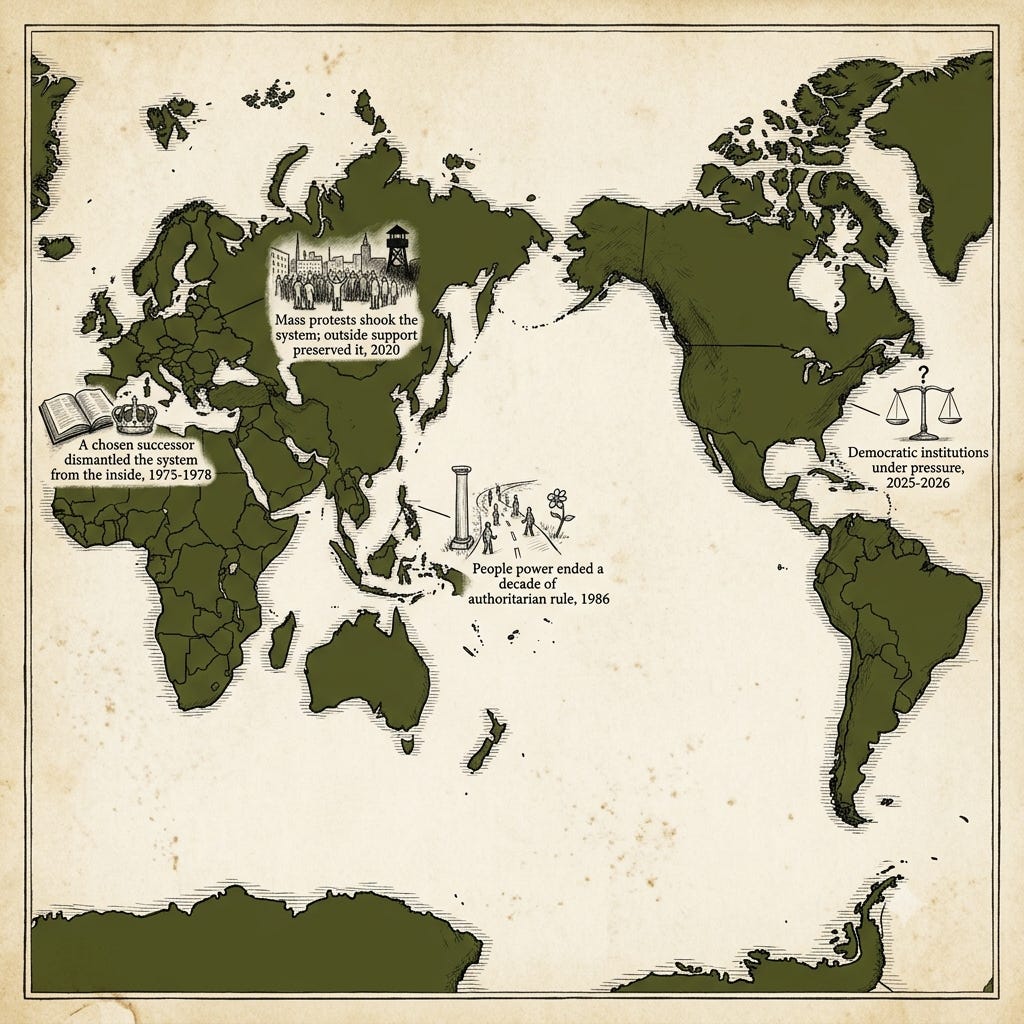
Alexander Lukashenko of Belarus offers the most recent completed example of the technique, and also its most troubling contemporary variant. After the August 2020 presidential election, which independent observers and the vast majority of Belarusians considered fraudulent, the largest protest movement in Belarusian history brought hundreds of thousands of people into the streets of Minsk. Workers went on strike. Police officers resigned rather than beat protesters. Lukashenko’s grip appeared genuinely precarious.
Then Russia intervened. Not militarily at first, but with money, intelligence support, Russian state media, and the implicit guarantee that Belarus would not be allowed to transition democratically. With that external lifeline, Lukashenko survived. The protests were crushed. Thousands were arrested and tortured. In 2022, a new constitution was passed that spread power across institutions Lukashenko controlled, reducing his personal legal exposure while entrenching the system's architecture. Belarus today is more repressive than it was in 2019.
The Belarusian case contains the warning that the Philippines and Spain do not. Outside support can preserve a regime that has lost its domestic legitimacy. When a strongman’s coalition fractures, when the military wavers, when the people fill the streets — an external patron with resources and political will can reset the equation. The people’s power alone is not always sufficient if a powerful neighbor has decided that democratic transition is against its interests.
This is the tenth and last installment of The Strongman’s Playbook. It is a ten-part series examining how authoritarian leaders consolidate power once they have won office. One technique per installment. The historical cases do the argumentative work.
If you subscribe now, you can follow the next series on How Democracies Fight Back, with a focus on the techniques of resistance. It also gives you access to the previous series in the archive, like The Fall, a ten-part series on how authoritarian regimes end.
New subscribers get 20% off the first year:
The American situation is incomparably more complex and more robust than any of these cases. The United States has deeper democratic institutions, a richer civil society, a more independent judiciary, a more professionalized military, and a longer democratic tradition than the Philippines in 1986, Spain in 1975, or Belarus in 2020. None of the historical parallels is exact. But the techniques being applied are recognizable, and their cumulative effect is the same: making the system resistant to democratic correction.
In ten states, Republican congressional maps have been redrawn at mid-decade, outside the normal redistricting cycle, at Trump’s direct urging. Republicans gained an estimated structural advantage in sixteen seats through these maps. Texas alone was restructured to create opportunities for five additional Republican seats. In Missouri, the Secretary of State rejected a petition signed by more than 300,000 citizens seeking a public referendum on the new map.
The SAVE Act passed the House in April 2025. The SAVE America Act passed the House in February 2026, 218 to 213, adding nationwide photo ID requirements and restrictions on mail voting. Federal courts have blocked portions of related executive orders on voting, but the legislative efforts continue.
On June 3, 2026, Trump signed an executive order converting approximately 8,000 senior policy-influencing civil service positions into Schedule Policy/Career — the restructured Schedule F system that strips career civil servants of their normal protections against political dismissal. The structural consequence is that any future administration inheriting this civil service will find a workforce reshaped for political compliance rather than professional independence.
The DOJ’s internal watchdog capacity has been substantially weakened. The Office of Professional Responsibility fell from 29 to 16 staff members. The Inspector General’s office lost nearly 100 employees while misconduct complaints surged to a twenty-year high. More than 40 career prosecutors were removed with letters stating they could not be trusted to faithfully implement the president’s agenda.
The military has undergone its most significant leadership restructuring in decades. General C.Q. Brown, the Chairman of the Joint Chiefs, was fired in February 2025 along with five other senior officers. The top military lawyers were removed across the Army, Navy, and Air Force. General Christopher Donahue was forced to retire in June 2026 with no public explanation. The pattern is not that any individual officer was necessarily defiant. The pattern is that institutional independence and professional continuity have been systematically reduced.
And Vance is being prepared. Trump told advisers in February 2026 that he favored Vance for 2028, describing him as having “earned it.” By July 2026, senior Trump advisers were saying publicly that Vance was the clear heir. This is, on one reading, normal political succession. On another, it is the deliberate cultivation of a loyalist heir who will maintain the political architecture that has been constructed — the captured courts, the weakened civil service, the restructured military, the gerrymandered maps, the election laws designed to make unfavorable outcomes harder to achieve.
Read together, the four mechanisms form a system.
Make losing harder: redistricting, voting restrictions, federal involvement in voter rolls, limits on mail ballots.
Make unfavorable results easier to discredit: the manufactured doubt about election integrity, the July 16 speech, the appointment of loyalists to agencies that produce official data, the firing of officials who produced unwelcome numbers.
Weaken the institutions that could resist: the DOJ watchdogs, the career prosecutors, the military lawyers, the civil service protections, the grant-funded civil society organizations.
Preserve the movement beyond the constitutional term: Vance, the succession planning, the third-term comments, the constitutional amendment introduced three days after the inauguration.
The political scientists Steven Levitsky and Lucan Way call this architecture “competitive authoritarianism” — a system in which elections continue but the playing field has been so systematically tilted that the incumbent’s party enjoys structural advantages genuine democratic competition cannot tolerate. Levitsky and Daniel Ziblatt, in How Democracies Die, described the earlier warning signs: the erosion of norms, the testing of guardrails, the incremental capture of institutions. Both books were written before this moment. Both describe it with uncomfortable precision.
What history shows — from the Philippines to Spain to Belarus — is that even the most carefully constructed systems of permanence eventually face a moment of fracture. The military splits. The business elite recalculates. The people fill the streets. The external patron withdraws, or the cost of support becomes too high. When that moment comes, what determines the outcome is whether enough independent institutions survive intact to make democratic recovery possible — and whether enough people have the knowledge, the organization, and the will to act.
That is the lesson the strongman’s playbook, read in its entirety, finally delivers.
Look back at what the ten techniques have been, in order. Capture the courts. Rewire the media. Corrupt the business elite. Hollow out the civil service. Weaponize the law. Rewrite history. Manufacture the enemy. Buy the base. Strangle civil society. Make leaving impossible.
Each technique weakens a different institution. Each weakened institution makes the next technique easier to execute. The courts captured in Part 1 cannot stop the media being rewired in Part 2. The media rewired in Part 2 cannot expose the business corruption in Part 3. The business elite captured in Part 3 funds the base-buying in Part 8. The civil society strangled in Part 9 cannot organize the resistance that would make leaving impossible in Part 10. The playbook is not ten separate moves. It is one continuous operation, each step making the next one possible.
And yet: Marcos fell. Franco’s system died with him. Lukashenko is still there, but only because Russia props him up — and Russia will not prop him up forever.
They all fell, or will fall, because the playbook has a flaw. It can weaken institutions, but it cannot eliminate the people who believe in them. It can intimidate civil society, but it cannot make citizens stop knowing what is true. It can rewrite history, but it cannot make people forget what they experienced. It can manufacture enemies, but it cannot make everyone believe the lies.
The people on EDSA in Manila did not have tanks. They had flowers and food and the collective decision that they would not accept what was being done to their democracy. That decision, made by enough people at the same moment, was sufficient.
The playbook is now complete. What comes next is the other half of the story.
This is the final installment of The Strongman’s Playbook — a ten-part series examining how authoritarian leaders consolidate power once they have won office.
If you have followed all ten parts, you now understand the complete architecture: how courts are captured, how media is rewired, how business elites are made dependent, how the civil service is hollowed out, how the law is weaponized, how history is rewritten, how enemies are manufactured, how bases are bought, how civil society is strangled, and how leaving is made impossible. The techniques are not random. They are a system. And systems, once named and understood, can be resisted.
The next series is called How Democracies Fight Back. Ten installments. One technique per installment — but this time, the techniques of resistance rather than consolidation. What has actually worked, in what circumstances, and why. From the Polish underground press under martial law to the South Korean candlelight revolution of 2016, history has documented in considerable detail what stops a strongman. The series begins next weekend.
If you have been reading for free, now is a good time to subscribe. You will be in time for the next series from the beginning.
New subscribers get 20% off the first year:
Stay inspired,
Alexander

More from Alexander Verbeek:
✍️ More: where I publish 🧭 Morning Compass and 🎙️ Morning Comments
🧭 The Morning Compass is the best way to quickly catch up on the more serious news that’s going on during your first coffee. I also share what to expect in today’s news, what happened on this day in history, what I recently published, what I captured, and what I stumbled upon.
🎙️ My Morning Comments are short videos where I dive a little deeper into the story that stood out most that morning.

☕️ Daybreak Notes & Beans: Every morning before dawn, I search for the best news you didn’t see. Science breakthroughs, conservation wins, human kindness, and beauty — delivered in time for your first coffee. Published most days of the week, positive, and unapologetically hopeful.

Screen Skills: A tech newsletter for non-tech people. Short, practical digital literacy guides for people who want to use their devices with more confidence. No jargon, no condescension. Usually, I publish it every other working day.

The Curious Wanderer
Storytelling, mostly about travel, experiences, and history. I write The Curious Wanderer for people who like to move through the world slowly and look at it carefully.
If that sounds like you, please subscribe to my smallest and most personal newsletter below. There is a paid option for those who want to support the writing directly.

If you are not ready for a subscription but want to show your support, buying me a coffee goes a long way. ☕️

Notes and sources
Trump “shouldn’t even have an election”: Reuters interview, January 15, 2026 — https://www.reuters.com/world/us/five-takeaways-reuters-interview-president-trump-2026-01-15/
Trump “I’m not joking” on third term: NBC News interview, March 30, 2025 — https://www.cbsnews.com/news/trump-third-term-nbc-interview/
Rep. Andy Ogles constitutional amendment: Congress.gov — https://www.congress.gov/bill/119th-congress/house-joint-resolution/29
Trump July 16 primetime address on election integrity: Reuters — https://www.reuters.com/legal/government/with-midterms-deck-trump-deliver-primetime-speech-election-security-2026-07-16/
Republican mid-decade redistricting, ten states: Reuters — https://www.investing.com/news/politics-news/how-republicans-won-the-2026-us-congressional-redistricting-war-state-by-state-4738038
Missouri referendum rejection: AP News — https://apnews.com/article/5cfa5294a987388f38e0960e3368d320
SAVE Act, April 2025: Congress.gov — https://www.congress.gov/bill/119th-congress/house-bill/22
SAVE America Act, February 2026: The Guardian — https://www.theguardian.com/us-news/2026/feb/11/house-save-act-trump-elections-bill
Schedule Policy/Career executive order, June 3, 2026: White House — https://www.whitehouse.gov/fact-sheets/2026/06/fact-sheet-president-donald-j-trump-increases-accountability-in-the-federal-workforce/
DOJ watchdogs gutted, misconduct surge: Reuters, August 6, 2026 — https://www.reuters.com/legal/litigation/trumps-doj-watchdogs-gutted-misconduct-complaints-soar-2026-08-06/
Military leadership purge, General Brown fired: Reuters, February 2025 — https://www.reuters.com/world/us/trump-pushes-out-top-us-general-nominates-retired-three-star-2025-02-22/
Vance as Trump’s designated successor: Axios, July 2026 — https://www.axios.com/2026/07/06/vance-summer-trump-heir
Philippines EDSA people power, 1986: Raymond Bonner, Waltzing with a Dictator, Times Books
Spain’s democratic transition, Juan Carlos and Suárez: Paul Preston, The Triumph of Democracy in Spain, Methuen
Belarus 2020 protests, Russian intervention, 2022 constitution: Andrew Wilson, Belarus: The Last European Dictatorship, Yale University Press
Competitive authoritarianism: Steven Levitsky and Lucan Way, Competitive Authoritarianism, Cambridge University Press
How democracies die: Steven Levitsky and Daniel Ziblatt, How Democracies Die, Crown
"The playbook is not ten separate moves. It is one continuous operation, each step making the next one possible."
Thank you for this meticulous examination and analysis of the strongman history and our potential options. We look forward to the next critical series and for us, a critical juncture.
“The technique does not require a declaration of dictatorship. It requires engineering the conditions in which democracy cannot reliably produce an unwelcome outcome.”
Trump has put the pieces in place to assure the loyalty of those who do his bidding, Todd Blanche being the most recent. The difference between Marcos and America now is that the tanks would not stop.
America and American democracy are in an extremely daunting state at present but hope remains strong: “They all fell, or will fall, because the playbook has a flaw. It can weaken institutions, but it cannot eliminate the people who believe in them. It can intimidate civil society, but it cannot make citizens stop knowing what is true. It can rewrite history, but it cannot make people forget what they experienced. It can manufacture enemies, but it cannot make everyone believe the lies.”
The Strongman’s Playbook is a remarkable analysis of how democracies weaken, fail, survive. It is a brilliant opus of your writing expertise and we, the readers, are the beneficiaries. Thank you for the countless hours and work you have put into this essential reading. I look forward to How Democracies Fight Back.