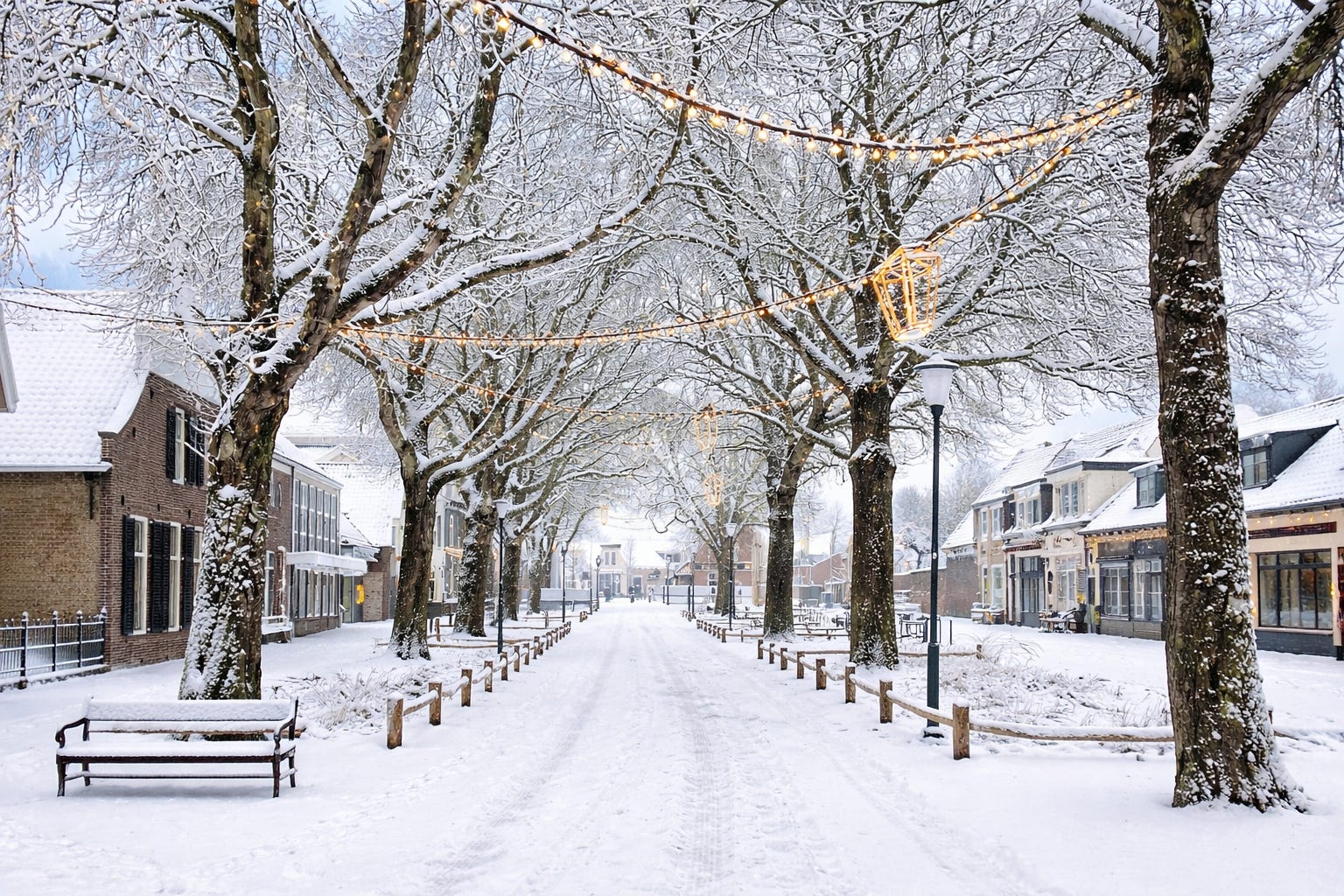
When the Country Stopped

A few days ago, I woke up with a strange light in the bedroom, as if the world had turned a whiter shade of pale. I looked out the window and saw an unusual layer of snow and clouds, which predicted more snow for the rest of the day.
I grabbed my phone and headed out. My snow boots are in Norway, so I did what everyone here does: I put on my wooden shoes.
Walking in klompen
Everyone in Dutch villages owns wooden shoes for garden work and wet conditions. They’re waterproof, they’re indestructible, and snow doesn’t bother them.
The problem starts about halfway through your walk. Snow collects under the sole and packs into ice. Suddenly, you’re standing on an unexpected 10-centimeter-wide platform. One step, you’re fine. The next step feels like stepping on a rock. You stumble, grab the nearest lamppost, pull off the shoe, and bang it against the post until the ice falls away.

I walked lamppost to lamppost through Burgh-Haamstede, stopped at Café La Baguette to warm up and clear more ice, then kept going. In towns, you won’t see wooden shoes except in tourist shops. But on your own land, in your garden, during wet weather? Everyone wears them.
During a brief stop at the local supermarket on the way back, a German tourist politely asked if she could take a photo. So now I’m somewhere in a German family photo album as that real Dutchman, a local day tripper with wooden shoes and all, posing with cheese and bread in my hands. Remembering my brief half-hour effort for a modeling career in Oslo that I wrote about in December, I’m making progress; this month, it’s not my hands but my feet that get all the attention.
This is the castle at the center of the village. A snowman sits quietly next to the bench, admiring the castle. Witte van Haamstede is in the foreground. He was a knight from about 800 years ago, the only historically notable person this village ever produced. Witte is an old Dutch first name that nobody uses anymore. It means white.
His statue is normally black. With snow covering him, Witte finally matched his name.
Tables and chairs that host tourists in spring and summer are now buried. In a few months, these will be packed.
Twenty-three days versus three
When I was a child in the 1960s, the Netherlands averaged 23 snow days per year. The Dutch meteorological institute KNMI confirmed this week that in this decade, we only get about three.
Here on the west side of this Zeelandic island, next to the North Sea with its warm winter waters, we get even less. Most winters, none at all.
The children making snowmen in Burgh-Haamstede this week had never seen snow like this. Kids born during the January 2021 snowfall are only now old enough to build their first snowman. Climate change is the difference between 23 days of snow and three.

When the country stopped
While I walked through the village, the rest of the Netherlands came to a complete standstill.
Schiphol Airport cancelled over 2,800 flights. Hundreds of thousands of travelers were impacted. I’m one of them, but a lucky one; the house is heated, and I sleep in my own bed. I will simply fly another day. Many stranded passengers had taken the road to nowhere and had to sleep at the airport.
Schiphol is the third-most-connected airport in the world, after London Heathrow and Istanbul. The airport ran out of de-icing fluid. Good for three days of snow per year, stockpiling massive quantities doesn’t make economic sense. Having lived in many countries with much more severe winters than this thin layer of snow, I’m surprised how disruptive this weather has been. Imagine Ottawa would come to a standstill due to this pleasant winter weather.
The trains stopped too. The Netherlands has 6,000 rail switches that can freeze in winter weather. Installing heating devices for all of them would be expensive for three snow days per year. But Amsterdam became virtually unreachable by train for days. The whole system is so interconnected that one failure cascades everywhere.
Annelies van Vark from the Clingendael Institute described it well in an article in NRC-Handelsblad: we’ve built the Netherlands to be “incredibly efficient and cheap.” Just in time, just enough. In good times, this works. “But when one small thing goes wrong, everything falls apart.” She compared it to a Formula 1 car: hyper-optimized, not a gram too much weight, incredibly fast on a race track. Take it off-road, and you’re stranded.
I won’t argue that we should heat every rail switch or stockpile endless de-icing fluid for three days of snow per year. The cost-benefit analysis is real.
We should be honest about the choice though. We chose efficiency over resilience and optimization over preparation. In good times, this makes us wealthy and connected. In bad times (pandemic, war, climate disruption, hybrid attacks, political chaos), it makes us fragile. If there is a general feeling that bad times may arrive, it’s time to consider more resilience and preparation. The pandemic was another reminder of our vulnerability.
Walking through Burgh-Haamstede in wooden shoes, stopping at lampposts to clear ice, I lived a personal version of this national reality. I didn’t invest in keeping snow boots in the Netherlands because I rarely need them. When snow came, I improvised.
“Well enough” for a village walk is different from “well enough” for critical infrastructure. Hundreds of thousands of stranded travelers didn’t have the luxury of improvisation. They just wanted to get home.

What’s disappearing
I’m publishing these photos because they capture a disappearing experience. Snow days are vanishing. So is the experience of winter transforming familiar places. I don’t know when I’ll see Burgh-Haamstede like this again. Maybe next year. Maybe not for five years. Maybe never quite like this.
But even without snow, in this small village, on an island you’ve never heard of, the world outside seems further away than I ever experienced in the many other places where I’ve lived. Here, I can hold on a bit longer to the illusion that the world hasn’t suddenly decided to paint it black.
Climate change means fewer snow days. It also means our infrastructure decisions (optimized for a climate that no longer exists) will face more frequent testing. Not just from snow, but from heat waves, floods, droughts, and disruptions we haven’t imagined yet. Some of you may remember what I’ve written about our failure to imagine; you don’t know what you’ve got until it’s gone.
Twenty-three days in 1961, three days now.
I walked through the cold in wooden shoes, stopped at lampposts to clear ice, and took photos of a white knight who’s normally black. The world turned a whiter shade of pale for a morning. Soon enough, everything returns to its usual colors.
Winter is leaving. I’m documenting what’s left.

I am an independent journalist based in Europe, and I write about democracy, nature, and the intersection of politics and society. The Planet 🌎 is a reader-supported publication for those concerned about democratic backsliding and environmental collapse. To receive new posts and support my work, consider becoming a free or paid subscriber.
I also publish on Patreon:
My stories on Patreon are more personal and informal. The story you just read was actually for Patreon, but it kept growing and became more future-oriented, political, and environmental, so I decided to post it in The Planet newsletter as well. Last week I published this article on Patreon: A Frozen Walk Through the Dunes at Sunset
Or perhaps you enjoyed the article and would like to support my writing by buying me a coffee?
Still here?
I also write:
Screen Skills: the only tech newsletter on Substack specifically made for non-technical people. I share basic screen skills that any 20-year-old has instinctively developed in their reflexes, and that older generations often don’t even realize they need. These simple skills make your phone and desktop time more enjoyable. I promise to keep it really basic. Read it in three minutes, apply it in two minutes.
Have a look by clicking here:
Lat night, I published this Screen Skills newsletter: The Email Storage Solution That Frees Gigabytes in Minutes
You’ll learn:
How Apple Mail stores attachments separately from messages, making cleanup surprisingly simple
The Outlook method for removing individual attachments or saving and deleting them in batches
Why Gmail doesn’t offer a direct removal option and the practical workarounds that actually work
Settings that prevent future attachments from automatically downloading and filling your storage
The one backup step you must take before removing any attachments to avoid permanent loss
How email storage evolved from unlimited promises to today’s paid tiers and why attachment management matters more now
I also write Daybreak Notes & Beans, where I share ten positive news stories from the day.
Yesterday, I published:


Such lovely scenes in your photos. And I had to laugh thinking of your "modeling career" now advancing to feet in a German family photo album. Delightful!
Did you take a photograph of the wooden shoes?! Caked with snow, ice, surrounded by snowflakes?