

Third-Hottest Year on Record Gets Buried Beneath Trump Headlines
Berkeley Earth and Copernicus confirm what scientists predicted: warming accelerates while political chaos dominates headlines

The year 2025 was the third-warmest on record. That sentence should alarm everyone. Instead, it will disappear beneath today’s political headlines within hours.
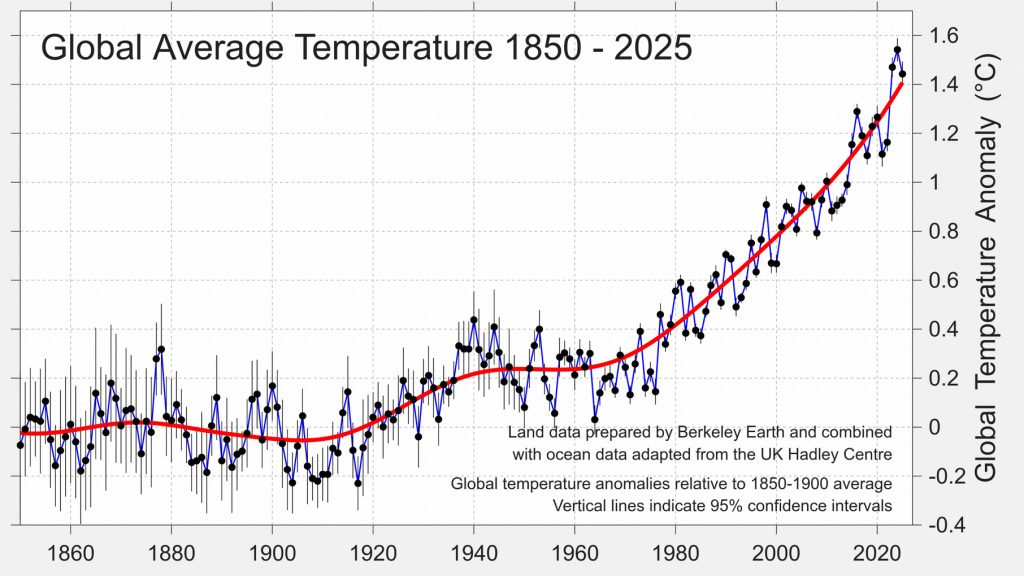
Berkeley Earth released its annual temperature report on Wednesday, confirming what climate scientists already expected: 2025 reached 1.44°C above pre-industrial levels. Only 2024 and 2023 were hotter. The last 11 years include all 11 of the warmest years ever recorded.
So every single year since 2015 has ranked among the 11 hottest years since thermometer measurements began in 1850. This is a fundamental transformation to a new era happening in real time.
The European Union’s Copernicus Climate Change Service reached similar conclusions. Their data shows the three-year average from 2023 to 2025 exceeded 1.5°C above pre-industrial levels for the first time. That’s the lower limit the Paris Agreement aimed to preserve. The goal isn’t dead yet—it’s measured over thirty years—but current warming rates suggest we’ll breach 1.5°C permanently before 2030.
That’s more than a decade earlier than scientists predicted when world leaders signed the Paris Agreement in 2015.
Beyond Greenhouse Gases
Robert Rohde, Berkeley Earth’s chief scientist, explained the recent warming spike clearly in a Zoom press conference today: “While greenhouse gas emissions remain the dominant driver of global warming, the magnitude of this recent spike suggests additional factors have amplified recent warming beyond what we would expect from greenhouse gases and natural variability alone.”
Those additional factors include sharp reductions in sulfur aerosol pollution from ships. In 2020, new international maritime rules cut allowable sulfur content in shipping fuels by roughly 85% overnight. Sulfur aerosols reflect sunlight and help form clouds. Removing them allowed more solar radiation to reach Earth’s surface.
This created an accidental geoengineering experiment. Cleaner air—which is good for human health—accelerated global warming. The North Atlantic and North Pacific, where shipping traffic concentrates, show the largest temperature increases.
Cloud cover changes also contributed. Satellite data reveals Earth’s reflectivity hitting record lows. Less low cloud cover means more sunlight is absorbed. Some of this reflects natural climate feedback, but the rapid pace suggests human activity plays a significant role through aerosol reductions.
The January 2022 Hunga Tonga volcanic eruption may have added to recent warming as well. Unlike typical eruptions that cool the planet by releasing sulfur, Hunga Tonga injected massive amounts of water vapor into the upper atmosphere. Water vapor causes warming. About half remains there today.
These factors combine with steadily increasing greenhouse gas concentrations. Carbon dioxide emissions set another record in 2025, rising 1.1% above 2024 levels despite the expansion of renewable energy.
770 Million People Experienced Record Heat
Berkeley Earth estimates that 770 million people—8.5% of Earth’s population—experienced locally record-breaking annual temperatures in 2025. About 450 million of those people live in China. The Antarctic recorded its warmest year ever, and the Arctic its second warmest.
In the Netherlands, where I am now, 2025 ranked among the top ten warmest years. The country recorded its sunniest year ever, aside from 2022. Dutch newspaper NRC noted somewhat dryly that increased sunshine benefits solar panel owners but won’t reverse climate change.
The Attention Problem
I’ve been following climate science for 15 years, organized international conferences, spoken at countless meetings and universities, and have always referred to climate scientists who predicted the patterns we’re seeing now. The science was already pretty solid in the early 1980s, and even though the data and knowledge have tremendously increased, the basic principles -and reasons to be alarmed- haven’t changed. The urgency has only increased.
What changed is attention.
Trump dominates the headlines. The War in Ukraine continues. The Middle East burns. Americans watch their democracy tested daily. Climate reporting gets buried beneath the political chaos.
This isn’t accidental. Authoritarian movements thrive when people focus on immediate crises and ignore long-term threats. Why invest in long-term security when you rule by creating permanent chaos to distract from the real issues? Climate change demands sustained attention, international cooperation, and long-term policy consistency. Let me add respecting facts and science to this list. Everything authoritarianism destroys.
Climate change won’t pause while America sorts out its political crisis.
Carlo Buontempo, director of the Copernicus Climate Change Service, put it plainly: “The world is rapidly approaching the long-term temperature limit set by the Paris agreement. We are bound to pass it. The choice we now have is how to best manage the inevitable overshoot and its consequences.”
Managing that overshoot requires the kind of sustained governmental focus and international cooperation that seems impossible right now. The US government just removed climate information from federal websites. Europe faces its own political turbulence. Meanwhile, greenhouse gas emissions keep rising.
I don’t know how to make climate change compete with daily political scandals for attention. I know it should. The planet doesn’t care about political cycles or news algorithms. Physics proceeds regardless of whether humans pay attention. But I know that for any long-term solution, we need all countries on board, including the world’s largest historical greenhouse gas producer. And to get there, the country needs a stable government, not a stable genius.
I am an independent journalist based in Europe, and I write about democracy, nature, and the intersection of politics and society. The Planet 🌎 is a reader-supported publication for those concerned about democratic backsliding and environmental collapse. To receive new posts and support my work, consider becoming a free or paid subscriber.

A new newsletter: More
There’s always more to say than fits in a daily newsletter. That’s why I started “More“—a place for follow-ups, deeper explorations, and the content that doesn’t fit the structured format here. Think of it as the notebook behind the newsletters.
You can read the first issue here:

And you can subscribe here:

Notes:
https://berkeleyearth.org/global-temperature-report-for-2025/?mc_cid=1a8bb52f35&mc_eid=8f4a451b5e
https://climate.copernicus.eu/copernicus-2025-was-third-hottest-year-record
"Climate change demands sustained attention, international cooperation, and long-term policy consistency. Let me add respecting facts and science to this list. Everything authoritarianism destroys."
Thank you for continuing to keep climate change in front of us. The US is overwhelmed with issues which should not be issues. News which should not be newsworthy. We should not be afraid for our neighbors. Nor for ourselves. Yet here we are.
Thanks for keeping Climate Change/Emergency in people’s minds Alex.
And then there’s the effect on our oceans.
More than 90% of the heat trapped by humanity’s carbon pollution is taken up by the oceans. This extra heat makes the hurricanes and typhoons hitting coastal communities more intense, causes heavier downpours of rain and greater flooding, and results in longer marine heatwaves, which decimate life in the seas. The rising heat is also a major driver of sea level rise.
https://www.theguardian.com/environment/2026/jan/09/profound-impacts-record-ocean-heat-intensifying-climate-disasters?CMP=Share_iOSApp_Other