



You may remember The American President, the 1995 romantic comedy in which Michael Douglas plays a widowed president who falls for an environmental lobbyist, played by Annette Bening. At one point, he wants to send her flowers and discovers that even this is complicated when you live in the White House. His credit cards are in storage somewhere in Wisconsin, the florist assumes the man on the phone is a prankster, and the Secret Service is hardly delighted by an unscheduled stop at a flower shop. Eventually, he realizes that the White House has a rose garden. Problem solved, although perhaps not the romantic gesture he had in mind.
In 1995, audiences found it perfectly believable that the president of the United States could have trouble buying a bunch of roses. Three decades later, the Pentagon has accepted a Boeing 747 from Qatar for Donald Trump’s use. The plane was described as worth hundreds of millions of dollars, and converting it for presidential service has cost American taxpayers hundreds of millions more. Trump has talked about the aircraft eventually going to his presidential library, although its ultimate ownership has not been settled. I wonder what President Shepherd, still hunting for his credit cards, would make of that.
The plane is not even the biggest number. In January, Democratic staff on the House Oversight Committee estimated that Trump and his family had generated nearly $2.25 billion in realized profits linked to his presidency. Billion, with a B. It is the committee Democrats’ estimate, not a court judgment, but it gives an idea of the scale of the financial interests now under scrutiny.
On Tuesday, Americans vote in an election that could change who in Congress has the authority, and the appetite, to examine them.
Americans are angry, and they say why
Americans may disagree about what constitutes corruption, but they seem increasingly united in believing that Washington has become a very profitable place for the people who run it.
A Harris Poll conducted for The Guardian in late October found that 76 percent of respondents believed elected officials cared more about enriching themselves than improving the economy for ordinary people. In the same poll, 36 percent named the cost of living as their most important voting issue. A separate Brennan Center survey found that 88 percent of registered voters blamed corruption for the government’s failure to solve major problems, including the economy. The surveys ask different questions, but they point to a connection worth taking seriously. For someone struggling with prices and bills, a political class that appears to be getting richer is hardly an abstract ethics problem.

Much of the campaign has been about the economy, healthcare, immigration, and the familiar political battles. The question of who benefits financially from government decisions is now part of it too. Whether Americans are angry enough seems settled. I wonder what that anger can actually achieve. Exposing corruption takes more than an election slogan. Someone has to obtain documents, summon witnesses, trace money through companies and accounts, and keep going when the people being investigated would prefer the whole thing to disappear.
What happened to the watchdogs?
Several parts of that machinery have changed during Trump’s second term. In January 2025, the administration dismissed 18 federal inspectors general, according to Reuters. Their job is to investigate waste, fraud, and misconduct inside government agencies, sometimes to the considerable annoyance of the people running those agencies. Republican Senator Chuck Grassley and Democratic Senator Dick Durbin questioned whether the administration had met the legal requirement to explain the dismissals to Congress. That the objection came from both parties deserves attention, because an inspector general who is welcome only when the findings are convenient is not much use.
In February 2025, Trump ordered a pause in most new investigations under the Foreign Corrupt Practices Act, the law prohibiting bribery of foreign officials. The Justice Department later resumed enforcement under revised priorities, and the administration said the changes served American economic and national security interests.
Ownership reporting changed too. The Financial Crimes Enforcement Network, FinCEN, is supposed to help authorities follow financial trails to the people behind companies. If an investigator finds a suspicious payment to a corporation, the name on the paperwork may lead to another corporation, and then another, until finding the actual owner becomes a small detective novel without the satisfying final chapter. In March 2025, FinCEN exempted American-created companies from the beneficial-ownership reporting requirement. In August 2026, it made that exemption permanent and announced it would delete previously collected information about U.S. persons. The government described this as regulatory relief.
These decisions affect different parts of the system, and they are not interchangeable. Together, they make the independence of oversight a live political question, the kind civics textbooks treat as settled. The next Congress can decide how vigorously to investigate the executive branch. It cannot, by itself, replace independent prosecutors and investigators. For what congressional persistence can achieve, consider a ranch in New Mexico a century ago.

The ranch that gave the game away
Albert Fall, President Warren Harding’s secretary of the interior, had money trouble. He owned a ranch in New Mexico and was behind on his property taxes. Then, in the early 1920s, he suddenly paid his debts, bought neighboring land, and made improvements to the property. A journalist named Carl Magee brought the curious change in Fall’s circumstances to the attention of Senate investigators. Where had the money come from?
The answer involved federal oil reserves, including a field at Teapot Dome in Wyoming. Fall had arranged leases to private oilmen without competitive bidding, and those businessmen had been generous to him in return. The investigation began through the efforts of a Democrat, John Kendrick of Wyoming, and a Republican, Robert La Follette of Wisconsin. A Democratic senator from Montana, Thomas Walsh, eventually took the lead. Harding was a Republican, and so was the Senate majority. That did not stop Walsh from spending more than a year pulling the evidence into public view.
Fall was eventually convicted of accepting a bribe and went to prison, becoming the first former American cabinet secretary imprisoned for a crime committed in office. The Senate hearings were not the criminal trial; prosecutors and courts did that work separately. But without lawmakers willing to investigate, the evidence might never have come to light. Teapot Dome also helped establish important precedents for Congress’s investigative authority.
It is worth remembering, before Tuesday’s vote, that the party that wins the House also controls its committees. Chairs decide which questions to pursue, which witnesses to summon, and which documents to demand. The answers are not always politically comfortable, including for the party asking the questions.
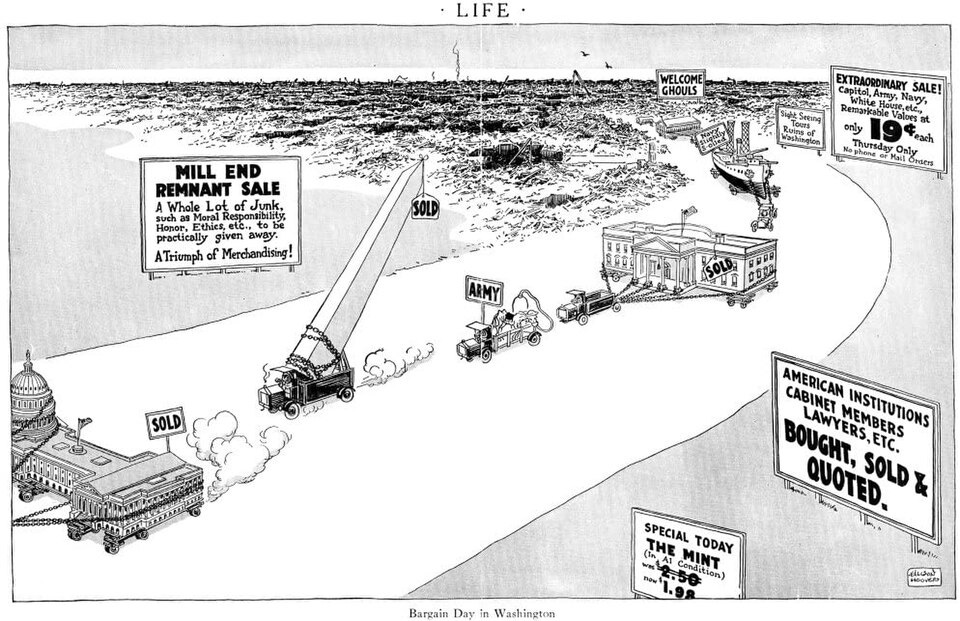
While looking into the Teapot Dome scandal, I came across this wonderful cartoon from 1924, published in Life magazine: “Bargain Day in Washington”. It shows Washington holding a gigantic clearance sale. The Capitol, the White House, and the Washington Monument have all been sold and are being carted away. Even responsibility, honor, and ethics are available at bargain prices.
A century later, with the White House’s East Wing demolished and hundreds of trees removed from Washington’s historic East Potomac golf course, the cartoon has acquired an unexpected contemporary flavor. Apparently, Washington’s demolition business is again booming.
What Milan could investigate
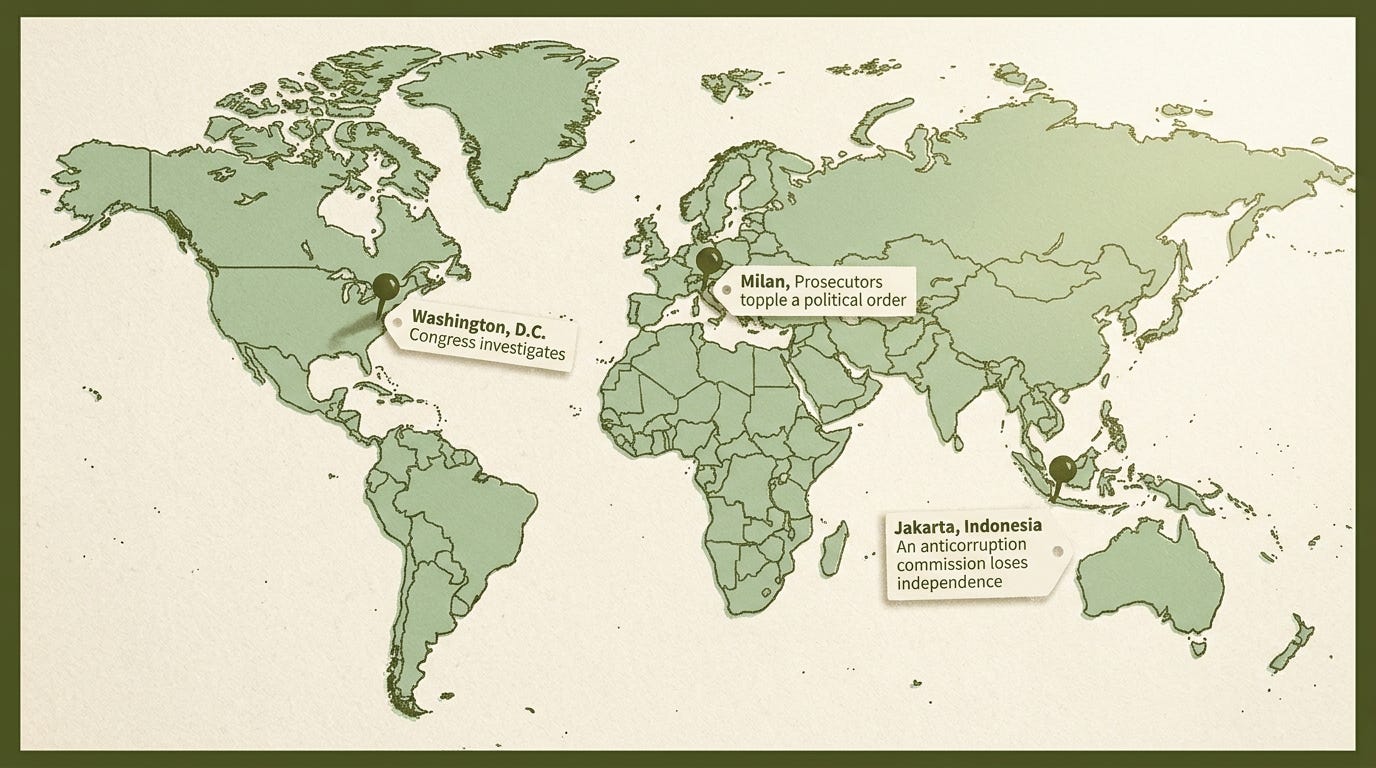
The Italian experience shows what happens when prosecutors, and not only politicians, have room to pursue the evidence. In February 1992, police arrested Mario Chiesa, a Socialist Party figure who ran a retirement home in Milan, after he took a bribe. It seemed like a modest local scandal, but the prosecutors kept following the trail and discovered a system of kickbacks involving businesses, public contracts, and political parties. Italians called it Tangentopoli, Bribesville. The investigations became known as Mani Pulite, Clean Hands, and eventually involved thousands of people. By 1994, the parties that had dominated postwar Italy had largely collapsed.
The Italian judiciary’s constitutional independence meant that political leaders could not simply order the prosecutors to stop. The investigation was not flawless, and the handling of defendants, including lengthy pretrial detention, drew criticism. Nor did the collapse of the old parties produce an immaculate new political order. Silvio Berlusconi arrived in 1994, bringing his business empire and its conflicts of interest into government. I have written about Berlusconi recently, so I won’t give him another entire article here. What interests me is that the prosecutors were able to reach people who had spent years assuming that nobody could touch them.
The president and his two rental houses
I lived in a small village in Indonesia in the second half of the 1980s. Corruption wasn’t my research topic, but it was impossible not to notice how thoroughly it had entered daily life. It began at the top, with President Suharto and the extraordinary business interests surrounding his family, and reached far beyond the ministries in Jakarta. His wife, Siti Hartinah, had acquired the memorable nickname Madame Tien Percent, after the ten-percent commission she was alleged to demand from government projects. It was the kind of joke that told you a great deal about the country, and about what people could and couldn’t safely say aloud.
After Suharto fell in 1998, investigators could examine his family’s fortune more openly. Transparency International later put the amount he was alleged to have embezzled at between $15 billion and $35 billion. Suharto himself had a rather different explanation for approximately $3 million in his Indonesian bank accounts. He said it came from his salary, careful saving, and rental income from two houses he had bought before becoming president. His explanation concerned those particular accounts, while investigators were examining allegations involving sums vastly larger. Suharto was never convicted; proceedings against him did not reach trial because of his ill health.
Indonesia created the Corruption Eradication Commission, the KPK, in 2002. It investigated senior officials and became a prominent part of the country’s effort to confront corruption. But in 2019, parliament changed the law governing the commission, introducing a supervisory board and weakening its independence. In 2021, a disputed civil-service assessment affected dozens of employees, and Indonesia’s Ombudsman found maladministration in the process. The KPK did not disappear. It kept its name and its offices, but its independence was reduced. That is one way a government can blunt a watchdog without the embarrassment of openly abolishing it.
What Tuesday’s midterms can change
The American situation is not identical to Italy in 1992 or Indonesia after Suharto. What these histories reveal is how much depends on the independence of the people charged with investigating government misconduct. Congress can hold hearings, subpoena witnesses, and expose documents. It cannot convict a president or send a cabinet secretary to prison. Prosecutors and courts have separate responsibilities, and their ability to act without political interference is essential.
On Tuesday, voters will help determine who runs the congressional committees that scrutinize the executive branch for the next two years. That will not resolve every allegation about Trump’s financial interests. It will influence which questions are asked in public and whether those in power face sustained demands for answers.
A hundred years ago, a senator noticed that a cabinet secretary had suddenly become much wealthier and demanded to know why. Today, the sums are measured in billions. The question is whether anyone with the power to investigate will insist on an answer.
Stay inspired,
Alexander
I am an independent journalist based in Europe, and I write about democracy, nature, and the intersection of politics and society. The Planet 🌎 is a reader-supported publication for those concerned about democratic backsliding and environmental collapse. To receive new posts and support my work, consider becoming a free or paid subscriber.

More from Alexander Verbeek:
☕️ Daybreak Notes & Beans
Every morning before dawn, I search for the best news you didn’t see. Science breakthroughs, conservation wins, human kindness, and beauty — delivered in time for your first coffee. Published most days of the week, positive, and unapologetically hopeful.

🎒 The Curious Wanderer
I write The Curious Wanderer for people who like to move through the world slowly and look at it carefully. If that sounds like you and you enjoy culture, history, and travel storytelling, you may want to join my travel newsletter. Please subscribe below; there is a paid option for those who want to support the writing directly.


🧭 Morning Compass and 🎙️ Morning Comments
🧭 The Morning Compass is the best way to quickly catch up on the more serious news that’s going on during your first coffee. I also share what to expect in today’s news, what happened on this day in history, what I recently published, what I captured, and what I stumbled upon.
🎙️ My Morning Comments are short videos where I dive a little deeper into the story that stood out most that morning.


📲 Screen Skills: A tech-newsletter for non-tech people. Short, practical digital literacy guides for people who want to use their devices with more confidence. No jargon, no condescension. Usually, I publish it twice a week.



Notes and Further Reading
U.S. Senate Historical Office, July 1, 2024. 100 Years Since Teapot Dome. This directly confirms Carl Magee’s testimony about Fall’s ranch and the involvement of Kendrick, La Follette and Walsh.
ANSA, February 17, 2017. Mani Pulite: il 17 febbraio di 25 anni fa il primo atto. This confirms Mario Chiesa’s arrest, the prosecution team, and the scale of the investigations.
ANSA: The Beginning of Clean Hands
The Guardian, October 30, 2026. Lauren Aratani, “Government corruption a top issue for US midterm voters, exclusive poll finds.” Supports the 76 percent figure, the 36 percent cost of living figure, the party comparison, and the survey dates and sample size.
https://www.theguardian.com/us-news/2026/oct/30/government-corruption-us-midterm-poll
Brennan Center for Justice, October 28, 2026. Marina Pino and Alex Brunet, “Voter Anger at Corruption Shapes 2026 Midterms.” Supports the 88 percent figure, bipartisan support for reform proposals, and the Texas and Iowa candidate examples.
https://www.brennancenter.org/our-work/analysis-opinion/voter-anger-corruption-shapes-2026-midterms
U.S. Capitol Visitor Center. “Senate Committee on Public Lands and Surveys hearing on the Teapot Dome oil leases, Senate Caucus Room, photograph, 1924.” Supports Walsh’s role, Fall’s leases and conviction, Daugherty’s resignation, and the two Supreme Court cases.
https://www.visitthecapitol.gov/artifact/senate-committee-public-lands-and-surveys-hearing-teapot-dome-oil-leases-senate-caucus
U.S. Senate Historical Office, “100 Years Since Teapot Dome,” July 1, 2024. Reported by ChatGPT to support the Carl Magee testimony and the roles of Senators Kendrick, La Follette and Walsh. UNVERIFIED: ChatGPT must confirm this is the page containing those details.
https://www.senate.gov/artandhistory/senate-stories/one-hundred-years-since-teapot-dome.htm
Senato della Repubblica. Constitution of Italy, Article 104. Supports the independence of the judiciary.
https://www.senato.it/istituzione/la-costituzione/parte-ii/titolo-iv/sezione-i/articolo-104
Senato della Repubblica. Constitution of Italy, Article 112. Supports the prosecutor’s obligation to initiate criminal proceedings.
https://www.senato.it/istituzione/la-costituzione/parte-ii/titolo-iv/sezione-ii/articolo-112
International Commission of Jurists, 1997. “Attacks on Justice, January 1996 to February 1997.” Supports the criticism of judicial procedures in the Clean Hands investigations.
https://www.icj.org/wp-content/uploads/1997/01/attacks-on-justice-january-1996-february-1997-publication-1997-eng.pdf
U.S. Department of State, 2023. “Investment Climate Statements: Indonesia.” Supports the 2019 weakening of the KPK.
https://2021-2025.state.gov/reports/2023-investment-climate-statements/indonesia/
Transparency International, Global Corruption Report 2004 — the $15–35 billion estimate.
Washington Post, April 27, 1986 — contemporary reporting on Mrs. Tien Percent.
Reuters, December 4, 1998 — Suharto’s explanation about the rental houses.
Ombudsman RI. “Ombudsman RI temukan maladministrasi dalam proses alih status pegawai KPK.” Supports the finding of maladministration affecting 75 KPK employees in the civil-service transition.
https://ombudsman.go.id/news/r/ombudsman-ri-temukan-maladministrasi-dalam-proses-alih-status-pegawai-kpk
Freedom House, 2022. “Freedom in the World: Indonesia.” Supports the controversy over the removal of KPK personnel.
https://freedomhouse.org/sr/node/5063
Reuters, January 28, 2025. “US Senate Judiciary Committee asks Trump to detail rationale for firing 18 IGs.” Supports the number of inspectors general dismissed and the joint request from Senators Grassley and Durbin.
https://www.reuters.com/world/us/us-senate-judiciary-committee-asks-trump-detail-rationale-firing-18-igs-2025-01-28/
U.S. House Committee on Oversight Democrats, August 15, 2025. Letter to 24 CFO Act agencies regarding inspectors general. Supports the January 24 dismissals and the notification requirements.
https://oversightdemocrats.house.gov/imo/media/doc/2025-08-15.garcia-et-al-to-24-cfo-act-agencies-re-oigs.pdf
The White House, February 10, 2025. “Pausing Foreign Corrupt Practices Act Enforcement to Further American Economic and National Security.” Supports the pause and the administration’s stated reasons.
https://www.whitehouse.gov/presidential-actions/2025/02/pausing-foreign-corrupt-practices-act-enforcement-to-further-american-economic-and-national-security/
U.S. Department of Justice, June 9, 2025. “Guidelines for Investigations and Enforcement of the Foreign Corrupt Practices Act.” Supports the revised enforcement priorities.
https://www.justice.gov/media/1403031/dl
FinCEN, updated August 2026. “Beneficial Ownership Information Reporting.” Supports the August 2026 rule and the exemption for U.S.-created companies.
https://www.fincen.gov/boi
U.S. Department of the Treasury, 2026. Press release on the beneficial ownership rule. Supports the announced deletion of previously reported information relating to U.S. persons.
https://home.treasury.gov/news/press-releases/sb0603
"Several parts of that machinery have changed during Trump’s second term. In January 2025, the administration dismissed 18 federal inspectors general, according to Reuters. Their job is to investigate waste, fraud, and misconduct inside government agencies, sometimes to the considerable annoyance of the people running those agencies."
Each step 47 has taken is a deliberate attempt at self profit and to obfuscate all the steps. Let's get passed Tuesday. Vote
A critically important piece for voters as Tuesday’s elections loom large. “Exposing corruption takes more than an election slogan. Someone has to obtain documents, summon witnesses, trace money through companies and accounts, and keep going when the people being investigated would prefer the whole thing to disappear.”
I think the Democrat House following January 6 showed they have the drive and perseverance to investigate these crimes. Whether the judiciary will support their findings is in question.
Another important thought: “It is worth remembering, before Tuesday’s vote, that the party that wins the House also controls its committees. Chairs decide which questions to pursue, which witnesses to summon, and which documents to demand. The answers are not always politically comfortable, including for the party asking the questions.”
The question of how the position of politicians can inexplicably change brings to mind today’s news of a shocking change of allegiance in the Michigan Senate race so important in these midterm elections. 30 pieces of silver?
Thank you for this excellent and extraordinarily timely writing.