After the Fall: What Happens When American Democracy Returns
Why democratic societies always recover, and why the recovery is never clean
I know that talking about the return of democracy will sound naive to many readers right now. Americans watch their institutions bend and break daily. The courts get stacked while the agencies get gutted, loyalists replace professionals, and every day feels like tomorrow’s news will be worse than today’s. But here in Europe, I have the advantage of distance. I don’t have to live through it myself. I can watch, read, compare, and think without the weight of it pressing on my daily life. And I’ve spent years studying this pattern over continents and centuries. No two countries face the same situation. But the patterns are unmistakable.
This will end. And when it does, the real question begins.
What do you do with the people who broke your democracy?
It is the question not many are asking yet.
Americans are focused on survival right now. On the next executive order, the next norm shattered, the next institution hollowed out. That makes sense when you fight the fire in front of you.
But I keep thinking about the day after. Not because I’m positive about timing. As I’ve stated before, I believe this gets worse before it gets better. Yet history is clear on one point: democratic societies with democratic traditions do recover. Spain recovered from Franco. Argentina recovered from the generals. Chile recovered from Pinochet. Brazil just convicted Bolsonaro for his coup attempt, sentencing him to 27 years. Central Europe was rebuilt after decades of communist rule.
The pattern holds. Authoritarian regimes in historically democratic countries collapse under their own weight. The extremism accelerates. The inner circle shrinks and begins to fracture. The competent people leave, and the loyalists prove to be exactly as incompetent as you’d expect. We are already seeing this pattern in the Trump administration. Chaos reigns when loyalty replaces competence as the primary qualification for power.
So the question is not whether American democracy returns. It is what Americans do when it does.
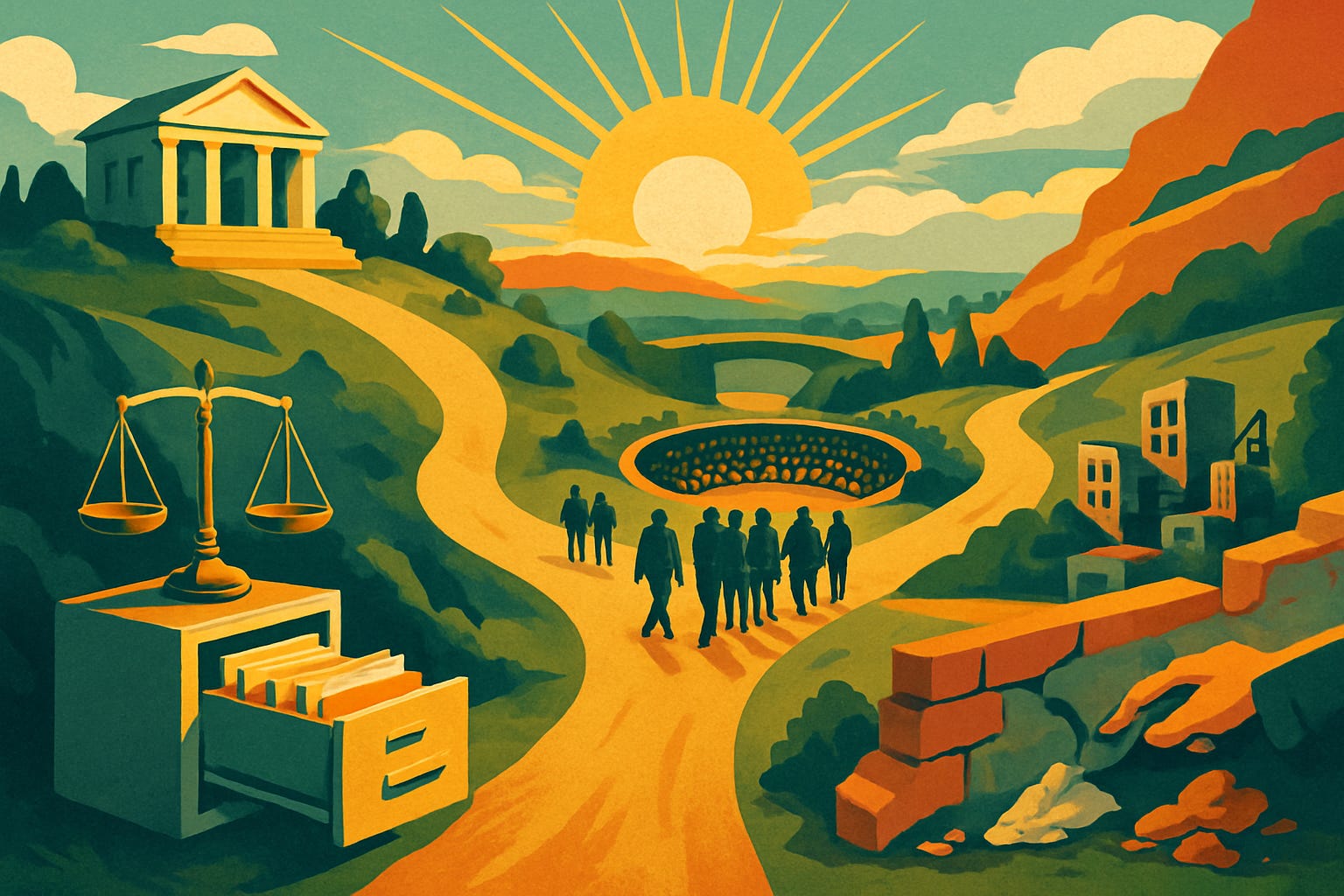
Three paths, three sets of consequences
I’ve spent the past weeks reading through the history of democratic transitions. From Buenos Aires to Berlin, from Cape Town to Prague, from Santiago to Brasília. None of these situations is identical to the others, and none is an exact copy of what is happening in the United States. There is no military junta in Washington. There is no apartheid system. There is no communist party running the state. I know these objections, and they are valid up to a point. But when you look at how democracies broke down and recovered across these different contexts, clear patterns emerge. Countries that restore democracy face three broad choices.
The first is prosecution. Put the people who broke the law on trial. Argentina did this in 1985, soon after the military dictatorship ended. The Trial of the Juntas put nine former commanders in a civilian courtroom. Over 800 witnesses testified. The lead prosecutor ended his case with two words that became a national rallying cry: “Nunca Más.” Never again. Videla and Massera got life sentences. Brazil followed the same path in 2025, convicting Bolsonaro and seven co-defendants for crimes that mirror those of January 6th.
The second path is truth over punishment. South Africa chose this after apartheid ended in 1994. Desmond Tutu chaired the Truth and Reconciliation Commission. It offered amnesty to perpetrators willing to confess fully and publicly. You would not go to prison, but you had to tell the country exactly what you did. Tutu believed South Africa was too fractured for mass trials. He considered that it was more important for South Africans to learn the truth than to lock people up. The commission delivered: it prevented a civil war, and the facts came out. South Africans learned what had been done in their name by their neighbors and their government. Many victims, though, felt cheated. Confession without consequence felt hollow to people who had lost family members. Knowing the truth is not the same as seeing justice done.
The third path is the quiet purge. After the Berlin Wall fell in 1989, East Germany didn’t hold mass trials. Instead, they opened the Stasi files. They barred former members of the secret police and collaborators from public office, teaching positions, and the judiciary. They vetted. They screened. They let society sort through its own complicity. The Czech Republic and Poland did similar things, with varying degrees of success and controversy.
Each path has costs. Each path has consequences that last for generations.
Why this matters now
I am not writing this as an academic project. I am writing this because I believe Americans need to start thinking about these questions before the crisis ends, not after.
When Argentina’s military dictatorship fell, President Alfonsín moved fast. Trials began within two years. That speed mattered. It established the principle that nobody was above the law, not even the generals who had held absolute power. But it also triggered a military backlash, leading to the Due Obedience laws, which granted immunity to thousands of mid-level officers. It took twenty more years and the Kirchner government to reopen the cases and finally deliver broader accountability.
The lesson is that accountability is never clean or simple, and, unfortunately, it is never finished in a single attempt. It stalls, retreats, and returns. Americans should expect the same.
And then there is the hardest question of all, one that Central Europe struggled with for years after 1989. What do you do with the ordinary collaborators? Not the leaders who gave the orders, but the people who carried them out. The ICE agents. The compliant judges. The bureaucrats who carried out policies they knew were wrong. The media figures who amplified lies for profit. And the prison guards. Americans still know very little about what is happening inside the detention facilities where immigrants and political targets are held. There are no civilian cellphones recording what goes on behind those walls. I fear that when this chapter ends, shocking accounts will emerge that the public has not yet begun to imagine.
East Germany’s answer was lustration: screen them, bar them from positions of trust, but don’t necessarily imprison them. Poland’s answer was messier, more politicized, and reopened wounds for decades.
Americans will face every one of these questions.
A European perspective on American denial
What strikes me most, watching from Oslo, is how little this conversation is happening in America. When I talk to American friends, they are either consumed by the daily crisis or convinced that Trump will simply lose the next election and everything will go back to normal.
Neither response accounts for what history teaches. Democratic recovery requires active choices. It requires institutions willing to prosecute. It requires a society willing to address uncomfortable truths about who collaborated and why. It requires leaders brave enough to focus on accountability over political convenience.
I grew up in the Netherlands, a country that still debates its behavior during the German occupation eighty years later. I lived in Germany not long after the Berlin Wall came down, when the Stasi files were being opened, and families were discovering who had informed on whom. I lived in Austria, which spent decades pretending it was Hitler’s first victim rather than his willing partner. I traveled through Eastern Europe while it was still under communist rule. These are not distant academic case studies to me. They are the places where I lived, worked, and watched societies wrestle with their past.
America will wrestle with its past too. The only question is whether Americans prepare for that reckoning or stumble into it.
What comes next
Over the coming weeks, I will examine each of these paths in detail. Part two will look at Argentina and Brazil: what happens when you choose to prosecute. Part three covers South Africa’s experiment with truth rather than punishment. Then, in part four, I will examine Central Europe’s quiet purge after 1989, and what it means for ordinary collaborators. I will bring everything together in part five: what model fits America, and what would justice actually look like?
Every authoritarian chapter ends. The next chapter is the one that defines whether a country truly heals or simply buries its wounds and waits for them to reopen.
Stay inspired,
Alexander
I am an independent journalist based in Europe, and I write about democracy, nature, and the intersection of politics and society. The Planet 🌎 is a reader-supported publication for those concerned about democratic backsliding and environmental collapse. To receive new posts and support my work, consider becoming a free or paid subscriber.
A new newsletter: More
There’s always more to say than fits in a daily newsletter. That’s why I started “More“—a place for follow-ups, deeper explorations, and the content that doesn’t fit the structured format here. Think of it as the notebook behind the newsletters.
You can read the latest issue here:
And you can subscribe here:
Notes:
Argentina Trial of the Juntas: Wikipedia, ‘Trial of the Juntas’ - https://en.wikipedia.org/wiki/Trial_of_the_Juntas
Argentina Trial of the Juntas background: Not Even Past, ‘The Trial of the Juntas: Reckoning with State Violence in Argentina’ - https://notevenpast.org/the-trial-of-the-juntas-reckoning-with-state-violence-in-argentina/
Argentina Trial of the Juntas: International Crimes Database, ‘Juicio a las Juntas Militares’ - https://www.internationalcrimesdatabase.org/Case/1118/Juicio-a-las-Juntas-Militares/
South Africa Truth and Reconciliation Commission: Encyclopaedia Britannica, ‘Truth and Reconciliation Commission, South Africa’ - https://www.britannica.com/topic/Truth-and-Reconciliation-Commission-South-Africa
South Africa TRC: Wikipedia, ‘Truth and Reconciliation Commission (South Africa)’ - https://en.wikipedia.org/wiki/Truth_and_Reconciliation_Commission_(South_Africa)
South Africa TRC 30 years on: Nelson Mandela Foundation, ‘Failing South Africa: the Truth Commission 30 years on’ - https://www.nelsonmandela.org/news/entry/failing-south-africa-the-truth-commission-30-years-on
South Africa TRC: South African History Online, ‘Tutu and his role in the Truth & Reconciliation Commission’ - https://sahistory.org.za/article/tutu-and-his-role-truth-reconciliation-commission
East Germany Stasi Records Act: Wikipedia, ‘Stasi Records Agency’ - https://en.wikipedia.org/wiki/Stasi_Records_Agency
East Germany Stasi lustration: Deutschlandmuseum, ‘Exorcizing the Stasi’ - https://www.deutschlandmuseum.de/en/history/calendar/1991-12-29-exorcizing-the-stasi/
East Germany Stasi Records Archive: CIPDH UNESCO, ‘Stasi Records Archive’ - https://www.cipdh.gob.ar/memorias-situadas/en/lugar-de-memoria/archivos-de-la-stasi/
Comparative lustration across Central Europe: ENRS, ‘Unread Files’ - https://enrs.eu/article/unread-files
Stasi Records Law: Encyclopaedia Britannica - https://www.britannica.com/topic/Stasi-Records-Law
Bolsonaro conviction: NPR, ‘Brazil’s Supreme Court sentences Bolsonaro to 27 years over coup plot’ - https://www.npr.org/2025/09/11/nx-s1-5535658/bolsonaro-brazil-coup-trial
Bolsonaro conviction: CNN, ‘Brazil’s former President Jair Bolsonaro convicted of plotting coup’ - https://www.cnn.com/2025/09/11/americas/brazil-jair-bolsonaro-coup-trial-verdict-latam-intl
Bolsonaro conviction: PBS NewsHour, ‘Brazil publishes ex-President Bolsonaro’s conviction for coup attempt’ - https://www.pbs.org/newshour/world/brazil-publishes-ex-president-bolsonaros-conviction-for-coup-attempt-starting-appeals-clock
Bolsonaro arrest: PBS NewsHour, ‘Bolsonaro arrested over alleged plot to escape’ - https://www.pbs.org/newshour/world/bolsonaro-arrested-over-alleged-plot-to-escape-and-avoid-27-year-prison-term-in-brazil
Brazilian coup plot: Wikipedia, ‘2022–2023 Brazilian coup plot’ - https://en.wikipedia.org/wiki/2022%E2%80%932023_Brazilian_coup_plot
Chile transitional justice: Amnesty International, Chile country reports - https://www.amnesty.org
Pinochet extradition: Human Rights Watch - https://www.hrw.org


"America will wrestle with its past too. The only question is whether Americans prepare for that reckoning or stumble into it."
I am consumed with this question. Many in this country are alarmed by how this regime operates daily. What most alarms me is the denial and ignorance Americans live in. They believe all will be well after elections. Then I ask if they're certain there will be an election. And I remind them what he promised during the campaign. "You'll never have to vote again." I look forward enthusiastically to your next parts of The Planet. Your analysis never disappoints.
"History never repeats itself. Man, always does."
To the keepers of the record: I have been licensed to sit in hundreds of Courtrooms, Grand Jury Chambers and Deposition Suites as the keeper of the record. Unless there is an official record, it is all for naught. Defendants cannot be sentenced; appeals cannot move forward and the U.S. Supreme Court is unable to set case law as Justices review transcripts/video of lower court proceedings.
The "record" of AG Bondi's testimony before Congress will be her shameful legacy. The record of the brave souls risking their lives to record ICE actions in Minnesota will stand the test of time; future generations will read about it and see the atrocities that America is currently going through.
But first there has to be a record. Our stories will be told, the arc of justice will land, and the American people will decide rightly or wrongly how to proceed. I am very grateful for the record keepers among us. Those who dispassionately verify history for the benefit of all. Herein lies our strength, our truth and ultimately here lies justice. Our impact.
You are a record keeper. In validating history, Alex, you show us the existence of truth. What we do with this truth is on us. The next chapter is waiting. Mil gracias.