


Yesterday evening, while I was finishing The Planet in Europe, Brazil was still voting. I wrote that I would return to the result later this week (you can read that article here). I did not expect to be back quite this quickly.
While Americans were sleeping, three remarkable developments came together in Brazil, Serbia, and Venezuela. Each had been years in the making. But the news arrived within the space of a single night, just eight days before Americans go to the polls themselves.
Brazil and the two extra hours
Luiz Inácio Lula da Silva has won a fourth term as president of Brazil, though not four in a row. Brazil’s Superior Electoral Court says he received 64,256,232 votes, or 51.79 percent. Flávio Bolsonaro received 59,826,041, or 48.21 percent. The margin is 4,430,191 votes. Lula trailed Bolsonaro after the first round and ran a hard campaign, so this is a remarkable comeback.
Bolsonaro refuses to concede. He says he will seek to have the result annulled. His complaint concerns a last-minute court decision to extend voting by two hours after transport problems and severe weather. Both campaigns had asked for more time. Supreme Court Justice Cristiano Zanin ordered the extension nationwide. Zanin used to be Lula’s defense lawyer, and Lula appointed him to the court in 2023. The decision created confusion because some polling stations had already closed before the extension was announced.
The electoral court says the extension did not change the outcome. Bolsonaro’s supporters dispute the fairness of the process, but they have not established that fraud determined the result. A margin of more than 4.4 million votes is substantial, and an allegation of fraud requires evidence.
Last night: An enormous crowd on Avenida Paulista celebrating Lula's reelection.
Brazilian presidential politics has provided enough material for several television series. Lula went to prison in 2018. Brazil’s Supreme Federal Court later annulled his convictions, and he returned to the presidency. Flávio’s father, former President Jair Bolsonaro, was convicted over an attempted coup following the 2022 election. Those cases have different legal histories, but together they illustrate the extraordinary turbulence of Brazilian politics.
There is also a very recognizable American dimension.
Jair Bolsonaro was one of Donald Trump’s most enthusiastic international admirers. Their political styles shared striking characteristics, including attacks on established institutions, hostility toward critical journalists, a willingness to question electoral procedures, and the portrayal of political opponents as enemies of the nation.
Both men lost presidential elections and challenged the legitimacy of the results. In Washington, Trump supporters stormed the Capitol on January 6, 2021. In Brasília, Bolsonaro supporters invaded Congress, the presidential palace, and the Supreme Court on January 8, 2023. The similarities are difficult to overlook.
Flávio Bolsonaro has maintained his family’s close political relationship with Trump. Now he has lost an election and is challenging the outcome. American readers have seen this story before.
Brazil has already prosecuted and convicted its former president for his role in an attempted coup. That gives the current dispute particular significance. The country has experienced what can happen when a defeated political movement refuses to accept an election, and now it faces another challenge to an electoral result.
Serbia and the movement without a leader
The other extraordinary election result came from Serbia, a country that probably receives much less attention in American news than it deserves.
For more than a decade, Aleksandar Vučić has dominated Serbian politics, first as prime minister, then as president. He resigned the presidency in September, making it possible for him to become prime minister if his party won the parliamentary election. He has maintained close relations with Vladimir Putin and Russia while also negotiating with the European Union. His government has faced persistent accusations of corruption, intimidation, and attacks on media freedom. He has survived for years by controlling institutions, dominating television, and keeping the opposition divided.
On Sunday night, he conceded defeat to a student-led movement that has no single leader.
With almost 99 percent of votes counted, the Student List had won 52.7 percent against 39.2 percent for Vučić’s alliance, according to Reuters. The students were projected to take 139 of the 250 parliamentary seats. Serbia had not seen such high electoral participation since the breakup of Yugoslavia.
It began with a concrete canopy.
In November 2024, part of the railway station in Novi Sad collapsed, killing 16 people. The station had recently undergone renovation, and the disaster became a symbol of the corruption and incompetence that many Serbians believed had become normal under Vučić. People wanted to know who had approved the construction, who had received the contracts, and why public infrastructure had become so dangerous.
Students began protesting. They occupied university buildings, organized marches, and demanded accountability. The movement spread beyond universities and drew support from teachers, professionals, farmers, and ordinary citizens. The demonstrations continued for nearly two years.
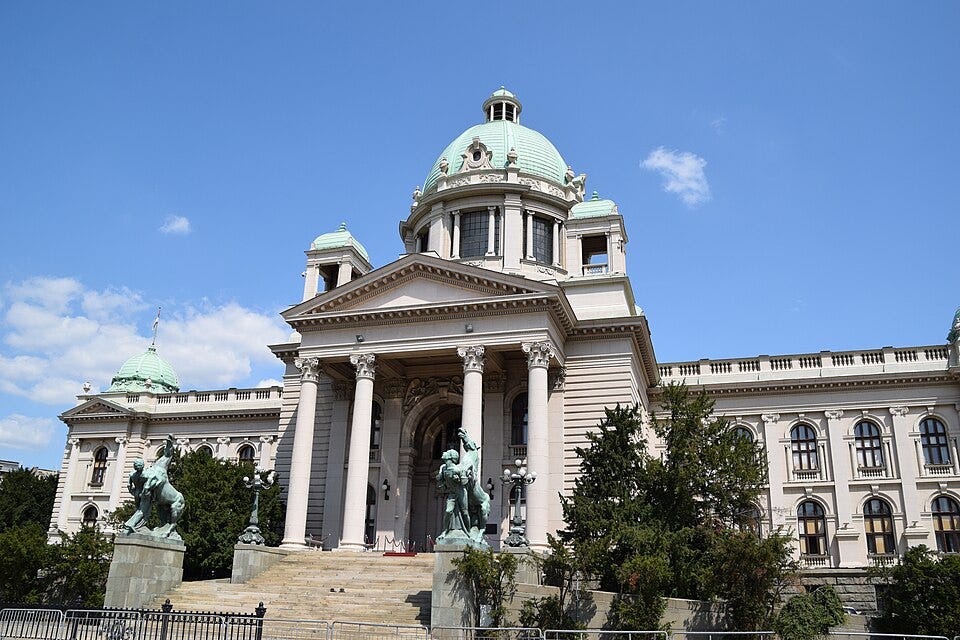
I have often written about the importance of sustained mass protests in European history, especially demonstrations that bring enormous crowds into the capital. Belgrade was the scene of one of the most important examples in October 2000, when protesters helped bring down Slobodan Milošević after he tried to disregard an electoral defeat.
What surprises me is how rarely we see comparable sustained national mobilization in Washington, DC.
The United States has its own history of enormous demonstrations in the capital. In August 1963, approximately 250,000 people gathered for the March on Washington for Jobs and Freedom. Martin Luther King Jr. delivered his famous I Have a Dream speech there. The march was part of a much broader civil rights movement, and it helped build pressure for the Civil Rights Act of 1964 and the Voting Rights Act of 1965.
The students in Serbia have now demonstrated what sustained protests can achieve. But their most remarkable achievement came when they had to turn those protests into an election campaign. They had no political leader, no established party machine, and no obvious candidate for prime minister. How they solved that problem is particularly interesting for Americans, just eight days before the midterms.